


The Ultimate Guide to Private tour of london for architecture lovers

For architecture lovers in London, United States, a private tour in London, England, offers a close look at a city shaped by centuries of design. The strongest private tour of London for architecture lovers follows a route shaped around your interests, bringing historic buildings and modern design into focus through the stories that connect them. From Roman-era traces to contemporary landmarks, the British capital rewards a curious, unhurried eye.
You may already have a few architectural icons in mind, but the pleasure often lies in understanding how each building responds to its era, setting and users. A private experience gives you room to linger over the details that matter to you, whether that means historic façades, bold post-war forms or the changing character of London’s streets.
This guide explores architectural periods and areas worth considering, how a tailored itinerary can reflect your interests, and what to look for in a private tour. You’ll also find practical ways to shape a day around the buildings you want to understand, rather than rushing from sight to sight.
Table of Contents
Historic and modern architecture around Guildhall
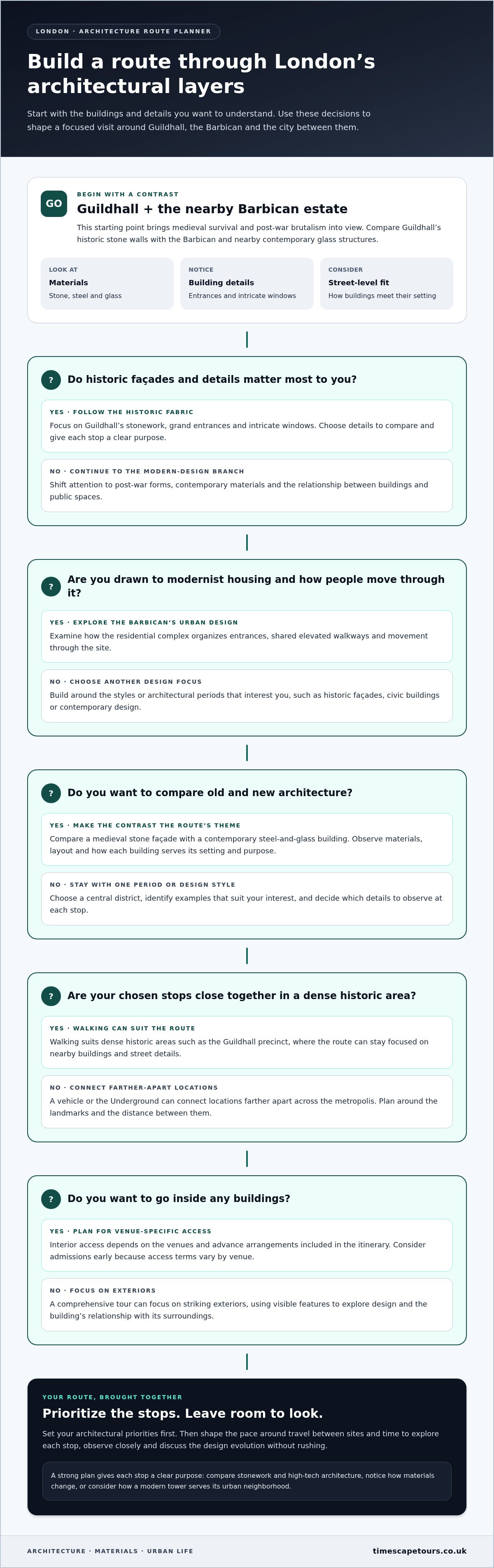
For an architecture-focused private tour of London for architecture lovers, begin with the historic and modern buildings you want to understand, then shape a route around them. The historic Guildhall and the nearby Barbican estate showcase a fascinating juxtaposition of medieval survival and post-war brutalism, offering an ideal starting point to understand the city's layered design evolution. Compare these ancient stone walls with the surrounding contemporary glass structures to appreciate how building materials, grand entrances, intricate windows, and street-level integration have transformed over the centuries.
A useful route can contrast older buildings with newer construction, focusing on how each serves its setting and purpose in the heart of the capital. Choose a central district, identify examples that interest you, and decide which details to observe at each stop. For instance, compare a medieval stone façade with a contemporary steel-and-glass building's materials and layout. This approach keeps the experience grounded in the historic fabric of London, England, allowing you to fully immerse yourself in world-class British design.
Modern and contemporary architecture can be explored through visible features such as structural framing, innovative materials, and the dynamic relationship between a building and nearby public plazas. For a modernist housing focus, examine how residential complexes like the Barbican organize entrances, shared elevated walkways, and movement through the site. These urban design elements are essential ways to read the cityscape during your customized exploration.
Are private architecture tours in London walking, driving, or accessible by public transport? The format depends entirely on your chosen route: walking suits dense historic areas like the Guildhall precinct, while a vehicle or the Underground can connect locations farther apart across the metropolis. Plan around the specific landmarks you want to see and the distance between them to maximize your time.
What are the best private tours for modern, contemporary, and historic architecture in London? Choose an expert-led itinerary focused on the specific design styles or architectural periods you want to explore, then build a comprehensive route around iconic London landmarks. A strong plan gives each stop a clear purpose, such as comparing medieval stonework with high-tech architecture or discussing how a modern tower serves its urban neighborhood.
How much do private architecture tours in London cost? The investment depends on the duration, transportation method, and customized itinerary. Contact Timescape Tours to discuss a private tour tailored specifically to your architectural interests and travel plans.
Do London architecture tours include entry to buildings, and are tickets extra? A comprehensive tour can focus on striking exteriors, while interior access depends on the specific venues and advance arrangements included in your package. Consider interior admissions as part of your early planning, since access terms vary significantly by venue.
How long do London private architecture tours last? The itinerary determines how much time you spend traveling between sites and exploring each stop. Set your architectural priorities first, then plan a comfortable pace that leaves ample time to observe the buildings closely and discuss their design evolution without rushing.
Custom itineraries based on visitors’ interests
A tailored architecture itinerary for London, Ohio, should begin with the buildings and streets you want to understand, rather than a preset list of landmarks. Choose a guiding interest, such as historic façades, contemporary design, civic buildings or residential architecture. Then identify local examples that suit that theme and group nearby stops into a practical route. This makes the visit more focused while leaving room to pause over details that catch your eye.
For a historic architecture focus, decide what you want to compare: building materials, entrances, decorative features or how a structure relates to its street. A contemporary-design itinerary could instead examine visible forms, window patterns and how newer buildings fit among older neighbors. These are observation themes, not claims about specific landmarks. Select actual stops in London, Ohio, based on the buildings you’re interested in seeing.
You can also build a route around a particular question. Ask how a building’s purpose shapes its exterior, or how a neighborhood’s character changes from one street to the next. Choose a starting point, prioritize the buildings that best illustrate your theme, then leave space for unplanned observations. A focused itinerary often creates more meaningful discussion than trying to include every possible stop.
What should visitors know about booking, cancellation, accessibility and weather policies? Review the booking and cancellation terms before making arrangements, and share mobility needs during planning so the route can account for walking distances and access requirements. For weather, consider a plan that balances outdoor viewing with indoor stops, and understand arrangements for changes beforehand.
Before setting out, make a short list of the buildings or architectural details that matter most to you. Decide whether you prefer walking between nearby stops or using a vehicle to connect separate areas. Share your priorities and access needs when planning, so the itinerary can reflect the places you want to visit and the pace that suits you.
A custom route can explore one theme in depth or compare different building types across London, Ohio. Keep the focus on local examples, and use each stop to notice how design, function and surroundings interact. That approach turns a walk through the city into a considered architectural experience, shaped by your interests rather than distant landmarks from another London.
A private driver-guide can shape a London architecture tour around your interests. Explain which periods, building types or design questions you hope to explore, then use those priorities to guide the itinerary. Consider whether you want to observe architectural details closely, compare styles or take a broader view of how buildings relate to their surroundings. Sharing these preferences gives your guide a clear starting point for tailoring the experience. Keep a few questions in mind during the tour and allow time to discuss details that draw your attention.
Architecture and urbanism
Architecture in London reveals how buildings respond to changing work, leisure and public life. British architecture has influenced design around the world through Britain’s colonial past, the Industrial Revolution and architects such as Norman Foster. Look beyond individual styles to consider how buildings shape streets, workplaces and shared spaces. Compare a civic building, a cultural venue and a place of everyday gathering: each offers a different account of the city’s priorities.
London’s pubs make that everyday dimension unusually visible. The city has over 3,500 pubs, and some have welcomed drinkers since the 14th century. Their architectural story also includes a notable period stretching from the latter end of the 19th century to the start of the 20th century. As you walk, notice how a pub’s frontage meets the street, how its entrance invites people inside, and how its position supports neighborhood life. These details connect design to social habits, rather than treating a building as a visual object alone.
The National Theatre offers another perspective on the relationship between architecture and public use. Its three distinct performance spaces invite visitors to consider how one institution accommodates different forms of performance. Look beyond the exterior: entrances, circulation and the surrounding public realm all shape how audiences arrive, gather and move through the building. Observe how people use the space, then connect that experience to its design.
For a broader city view, the Walkie-Talkie building’s Sky Garden sits on the 35th floor. From that height, London’s varied rooflines reveal how the city has grown through different periods and building ambitions. A guide can help visitors connect the skyline to street-level observations, such as changing scale, the placement of tall structures and the way commercial buildings meet older districts. Seeing both perspectives helps explain urbanism as a relationship between individual landmarks and the larger city.
Try this simple method at each stop: identify the building’s function, notice how its entrance meets the street, then compare its scale and materials with nearby structures. At a pub, consider the invitation of the frontage; at the National Theatre, consider how public movement serves cultural use. These observations make differences between architectural styles easier to describe in English, while grounding each interpretation in a visible example.
A thoughtful route connects these observations without turning the day into a catalogue of façades. Pair a historic pub with a contemporary public building, then use a skyline viewpoint to place both within London’s changing urban fabric. The contrast reveals how architecture records shifts in commerce, culture and everyday life, giving each landmark context beyond its appearance.
Architecture from Roman times to the present
The United Kingdom’s buildings span architectural eras and styles from Roman times to the present. In London, a chronological route helps make that range clear, even when visible landmarks represent later periods. Notice how each building answers a different need, from defense and royal power to civic life and modern housing. Link examples by period, then compare their materials, scale and function.
The Tower of London anchors an early stage of that journey. The Tower’s historic complex brings religious architecture into the setting of a royal stronghold. Look beyond the fortress outline: the chapel offers a way to notice how religious spaces sit within a royal stronghold. The Tower also demonstrates the evolution of royal buildings from the 11th to the 16th centuries, giving visitors a compact setting for observing architectural change over time.
Later royal architecture brings a different sense of scale. Construction of Kensington Palace began at the start of the 17th century, and the palace has 547 rooms. These details invite questions about how a royal residence organizes private life, ceremony and administration. During a visit, compare the palace’s overall arrangement with the smaller features that catch your eye, such as entrances, windows and the relationship between rooms and grounds.
London’s architectural story also includes Brutalism, which thrived from the mid-1950s through the 1970s. Its concrete forms make a striking contrast with older royal and civic buildings. The Barbican, built between 1971 and 1982, provides a strong example for looking at how a large residential complex combines homes with shared facilities. Its history helps explain why post-war architecture should be read as an urban environment, not only as an exterior style.
To follow this history on foot, use a simple sequence: identify a building’s period, consider its original purpose, then compare its design with the next stop. The Tower’s defensive character, Kensington Palace’s royal setting and the Barbican’s residential scale each tell a different story. This method keeps a walking journey focused while leaving room for close observation. It also brings the present into view, showing how London’s architectural layers reflect changing ideas about power, daily life and the city itself.
Brutalism thrived in London during the mid-1950’s and 70’s, making it useful to consider how a building’s appearance relates to the period in which it was made. Rather than treating concrete as a surface detail, look at how its mass and geometry shape the experience of moving through the Barbican. Shared spaces matter alongside the homes: they show how residential design can organize encounters and routines as well as provide shelter. This comparison can make the contrast with a palace more meaningful, since the two settings express different relationships between private space and collective life.
Kensington Palace in London was completed in 1899. Keeping that date in mind alongside its earlier construction history encourages a distinction between the beginning of a building project and its completion. On a walk, such differences can help explain why a building may carry evidence of more than one moment in its history. Notice which parts seem designed to guide movement, which establish a sense of formality, and how the grounds affect the approach. Reading these details together offers a way to compare architectural change without reducing each stop to a single style or date. It also makes careful observation a useful companion to the broader timeline.
Which London architectural landmarks and neighborhoods do private tours cover?
The route’s theme determines which landmarks receive the most attention. In the City, Guildhall offers a natural starting point for civic history, while the nearby Barbican provides a post-war contrast. Its residential, cultural and public spaces invite discussion about how architecture serves more than one purpose. Linking the two shows how different eras sit side by side, rather than treating each building as an isolated stop.
Across the Thames, the South Bank offers a distinct perspective on culture and adaptive reuse. Tate Modern occupies the former Bankside Power Station, turning an industrial structure into a major cultural destination. The National Theatre adds another perspective, with three distinct performance spaces. Together, these landmarks anchor a route exploring how public buildings welcome visitors, support cultural life and shape the riverfront.
Westminster suits visitors drawn to political and royal architecture. Westminster Hall has served a political function for almost 1,000 years, while the Tower of London illustrates the evolution of royal buildings from the 11th to the 16th centuries. Kensington Palace introduces a different royal setting, with 547 rooms. These sites can be explored as a focused royal and civic route, or selected individually to leave time for closer observation.
For contemporary landmarks, the City skyline offers a striking change of scale. The Shard stands 1016 feet tall and is the UK’s tallest skyscraper. The Walkie-Talkie building’s Sky Garden, on its 35th floor, provides a high-level view across London. In East London, Queen Elizabeth Olympic Park connects architecture with urban planning, having been built specifically for the 2012 Olympic Games. These destinations suit visitors interested in how major developments shape the city’s image and public spaces.
A useful way to choose is to group places by both geography and interest. Pair City landmarks for a compact contrast between civic and modern architecture, or follow the Thames between cultural buildings. Add Westminster for political history, Kensington for royal architecture, or Olympic Park for a planned urban landscape. A private route can prioritize walking near selected buildings, with driving between districts when broader coverage matters. The London Architecture Tour described earlier covers about 2 miles on foot, with distance varying by day and group interests.
For a wider first look at the capital’s landmarks, consider the London Panoramic Tour as a way to orient your choices before shaping an architecture-focused day.
Timescape Tours: Windsor Castle Tour
Timescape Tours offers private London tours for architecture lovers, as well as excursions beyond the capital. The London Panoramic Tour gives you a broader view of the city’s architectural character, while a Windsor Castle Tour continues the exploration of royal architecture beyond London. Choose the panoramic tour to discover the capital, or the Windsor excursion for a dedicated visit beyond it.
For a wider journey through England, Timescape Tours’ Stonehenge and Bath Tour and The Cotswolds Tour offer alternatives to a London-focused day. Each lets you shape your travels around the places and stories that interest you, rather than treating every destination as the same experience.
Contact Timescape Tours to discuss a private London tour shaped around your architectural interests.
Let your architectural curiosity shape the next journey
Start by deciding what you want the day to reveal: a particular architectural period, a neighborhood’s changing character, or the contrast between London and places beyond it. A private tour of London for architecture lovers can begin with the questions you’re eager to explore, then extend into a wider journey through England’s historic settings.
Timescape Tours offers a Windsor Castle Tour, a Stonehenge and Bath Tour, and The Cotswolds Tour, each providing a different perspective on England’s built heritage. Keep your plans centered on London, or use the capital as a starting point to discover other architectural landscapes. The choice depends on the stories and places you want to explore.
Share your interests and begin shaping a journey that reflects them. Contact Timescape Tours to plan your tour, and take the first step toward seeing London and England through an architectural lens.
Frequently Asked Questions
Can London architecture tours be customized for specific styles or periods?
Yes, a private tour of London for architecture lovers can focus on a chosen style, period or design question. Before planning, note the buildings you most want to see, whether you prefer street-level details or broader city views, and how you’d like to pace the stops. Your private driver-guide can use those priorities to shape the route and connect each example through a clear architectural theme.



Comments