


How to Travel Hassle-Free with Children from London: Rules

For families setting out from London, United Kingdom, child fares depend on the local transport service and its rules. Learning how to travel hassle-free with children from London starts with checking the fare policy for your route and planning meals and breaks around the day’s itinerary.
It’s easy to assume every child needs the same ticket, or that one rule applies to every journey. With Timescape Tours, a little preparation helps you compare routes, keep everyday costs in view, and make practical choices for your family.
This guide covers planning child-friendly transport, keeping meals manageable, preparing for airport or station departures, and packing for the journey. You’ll have a clearer framework for organising a family outing from London, United Kingdom, with fewer last-minute decisions.
Table of Contents
Picnics, groceries, and meal deals
Plan meals with a picnic or grocery stop, and build toilet breaks into the route. For naps and entertainment, keep a quiet rest option and a small activity within easy reach.
A picnic is a portable meal eaten outdoors or during a pause in sightseeing. Buy fruit, sandwiches, and water at a grocery store near your route, then choose a suitable place to sit. Keep food in a separate, accessible bag so children can eat without unpacking the family’s luggage.
A meal deal is a ready-made combination of food and drink sold together. Compare the options at a local supermarket or convenience store before buying. Check what’s included, especially if a child prefers familiar flavours or has dietary needs. A packed lunch can also make the day easier when nearby restaurants don’t fit your schedule.
A grocery stop is a brief visit to buy food for later, rather than a full meal out. Pick up breakfast items, fruit, and snacks near your accommodation or starting point. Divide them into portions before setting out, and keep one snack accessible in case of a delayed train or longer walk. This helps you fit meal breaks around a museum visit or another planned activity.
A toilet stop is a planned pause at a station, café, or attraction with facilities. Build one into the route before a long ride or visit to a large site. Encourage children to use the facilities when you stop for food, rather than waiting until departure time. Keep tissues and hand sanitiser in an outer pocket for quick access.
A nap break is a quiet pause that gives a tired child time to rest. Schedule it around the child’s usual routine, using a calm seat or a quieter part of the day. Pack a lightweight layer in case indoor spaces feel cool. Leave room in the itinerary for rest instead of planning back-to-back stops.
Travel entertainment is a compact activity that keeps children occupied between destinations. Pack a small colouring pad, a story, or downloaded audio that works without mobile data. Rotate activities during the journey instead of offering everything at once. Keep the chosen activity in a day bag, not buried beneath spare clothes.
A travel card is a payment card used for eligible public transport journeys. If a child needs a Zip Oyster photocard for travel in London, visitors must apply at least 28 days in advance, according to Transport for London. For a trip based in the United States, check the local transit authority’s child-fare rules and application process before departure. Pack snacks, water, and a simple rest plan so meals and pauses can flex around the day.
Travel rules for under-18s
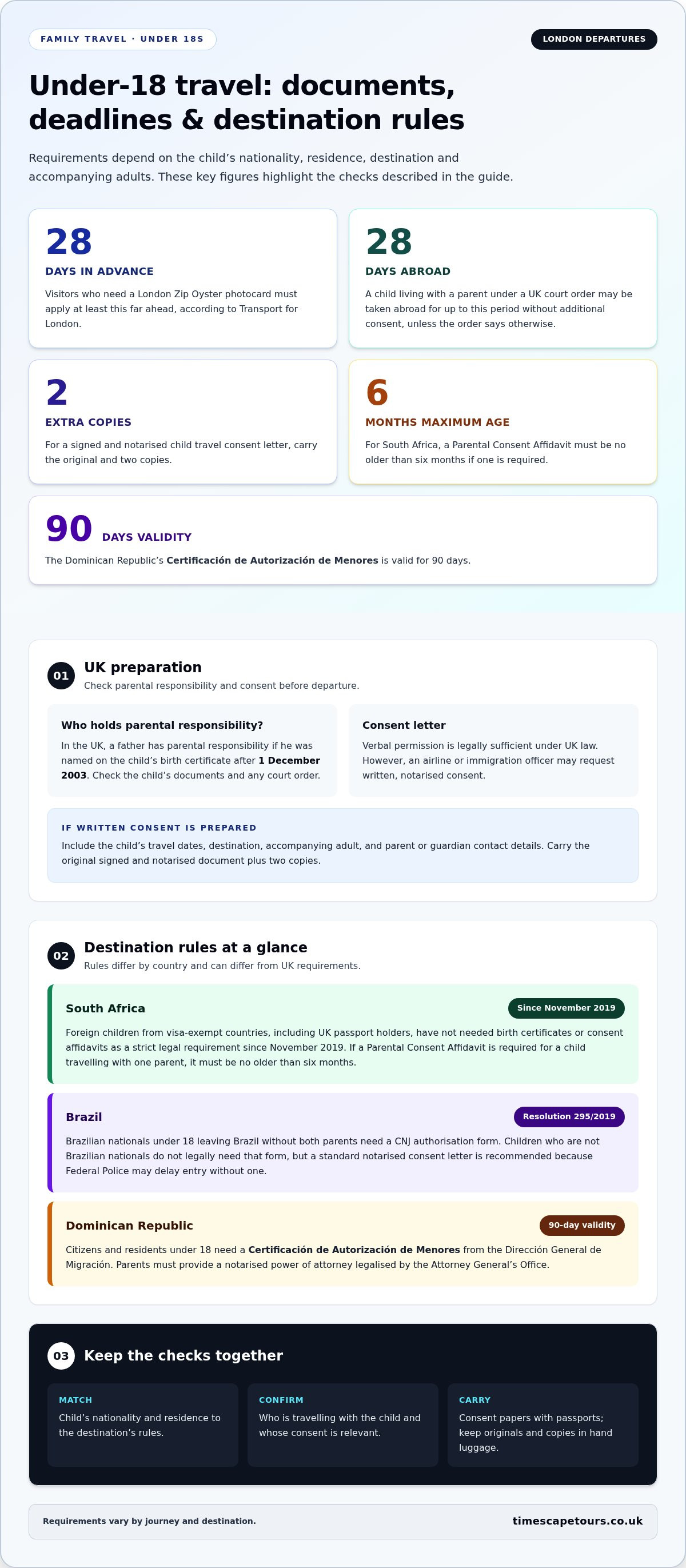
Parental responsibility is the legal authority to make decisions for a child. Before an overseas trip, identify who holds it and whether anyone else’s consent is relevant. In the UK, a father has parental responsibility if he was named on the child’s birth certificate after 1 December 2003. Check the child’s documents and any court order before setting out.
A court-order exception is a limited permission linked to where a child lives. According to the UK Government, a child who lives with a parent under a UK court order may be taken abroad for up to 28 days without additional consent, unless the order says otherwise. Read the order’s wording carefully, as its conditions may affect the journey.
A child travel consent letter is written evidence that a parent or guardian agrees to the trip. Verbal permission is legally sufficient under UK law, but airlines or immigration officers may request written, notarised consent. Carry the original signed and notarised document and 2 copies. Include the child’s travel dates, destination, accompanying adult, and parent or guardian contact details.
Destination entry rules are the requirements applied by the country a child is entering. They can differ from UK rules, so distinguish legal requirements from documents that may help explain a family’s circumstances. For South Africa, foreign children from visa-exempt countries, including UK passport holders, have not needed birth certificates or consent affidavits as a strict legal requirement since November 2019. If a Parental Consent Affidavit is required for a child travelling with one parent, it must be no older than 6 months.
Brazilian authorisation is a specific document rule for Brazilian children travelling without both parents. Brazilian nationals under 18 leaving Brazil without both parents need a CNJ authorisation form under Resolution 295/2019. Children who are not Brazilian nationals don’t legally need that form, but a standard notarised consent letter is recommended because Federal Police may delay entry without one.
Dominican Republic authorisation is the travel permission required for citizens and residents under 18. They need a Certificación de Autorización de Menores from the Dirección General de Migración. It is valid for 90 days. The process requires parents to provide a notarised power of attorney legalised by the Attorney General’s Office.
For a smoother departure from London, match the child’s nationality, residence, destination, and accompanying adults to the applicable rules. Keep consent papers with passports, and carry originals and copies in your hand luggage. This preparation makes it easier to explain family arrangements at airline check-in or border control.
What are the easiest ways to travel from London with children by train, plane, car, or coach?
Train travel means using the Underground, Elizabeth line, London Overground, or National Rail to reach a destination. For journeys within London, children under 11 travel free on the Underground, and up to four children under 11 can travel free with a fare-paying adult on the TfL network, including the Elizabeth line and London Overground. National Rail can have different child-fare rules, so check the route before setting off. Look for wider barriers at stations, which may make it easier to pass with children, luggage, or a pushchair. Keep tickets or payment cards within reach, and agree on a meeting point in case your group gets separated.
Air travel means reaching an airport from London and continuing by plane. Heathrow and London City airports are within London’s travel zones, so London child-fare rules apply there. Gatwick, Stansted, and Luton are outside those zones, and child fares depend on the train or route used. Before leaving, identify the airport and the station or terminal your route serves. With children, a direct train or coach may reduce changes, while a route with fewer interchanges can be easier with luggage. Keep passports and travel documents together, and explain the next step to children before changing transport.
Car travel means making the journey in a private vehicle, either your own or one arranged for your trip. It can suit families carrying several bags or travelling to places with limited public transport. Choose your route based on the destination, traffic conditions, and planned stops, rather than assuming the shortest map route will be easiest. Keep essential items within an adult’s reach without unpacking the boot. If your itinerary includes central London, consider whether parking and congestion make a car less convenient than trains for that part of the day.
Coach travel is a scheduled road journey between London and another town or airport. It can offer a direct route, but the departure point and arrival stop matter, particularly with tired children and luggage. Check whether the coach leaves from Victoria Coach Station or another London stop, then plan how your family will get there. Keep snacks, water, and entertainment in a small day bag. For an airport journey, compare the coach stop with the terminal and account for any onward connection before choosing your route.
For the simplest choice, write down your destination, luggage needs, and number of changes for each option. A 9-year-old travelling from Abbey Wood into London needs a ticket on Southeastern or Thameslink trains, but travels free on the Elizabeth line. That example shows why the operator and route matter as much as a child’s age. Match the transport mode to your family’s plans, then confirm each leg before departure.
How early should families arrive at London airports or train stations when traveling with children?
An arrival buffer is time set aside before departure for check-in, queues, and unexpected delays. There’s no single arrival time that suits every London journey. Start with the airline’s check-in, bag-drop, and boarding deadlines, then plan backwards from the flight. Allow time for your route to the airport, luggage, and children’s pace. Heathrow, Gatwick, Stansted, and Luton each require a plan based on the terminal and transport connection.
A check-in deadline is the latest time passengers can complete an airline’s required departure steps. Find it in your booking or the airline’s travel information, and note whether your family must check bags. Keep passports and boarding details together so one adult can present them while another manages bags or children. If your flight departs from Heathrow, identify the terminal before choosing a train or road route. A terminal change or extra connection affects how much time your plan needs.
A station arrival plan is a sequence of steps from the entrance to the correct platform. For London train journeys, identify the station, operator, platform information, and ticket or payment method before leaving home. At TfL stations, two wide ticket barriers can help families pass with luggage or larger items. Keep tickets accessible, then pause beyond the barriers before checking the platform display. This gives children space to regroup without blocking the flow.
A connection is a change between transport services or stations. For example, a family travelling to Gatwick might need to reach a London departure point before boarding the airport train. Allow time for the walk between platforms, lifts, toilets, and ticket gates, especially with a pushchair or several bags. If the route uses a weekday morning service, touching in before 9.30am incurs peak fares; the afternoon peak starts at 4pm on weekdays. Build the journey around the actual departure rather than assuming every connection runs directly.
A contingency plan is a simple alternative for a missed connection or delayed service. Choose a meeting point inside the station, such as a staffed information desk, and tell children what to do if the group separates. Keep the next service option and destination address available offline. At an airport, save the terminal and airline details together; at a station, note the operator and final destination. These steps help adults make decisions without searching through packed bags.
For a practical timing plan, work backwards from the departure time to the airline or train requirements, the route to the terminal or platform, and then family preparations. Check the day’s travel information before setting out, and account for any planned changes. London travel with children is easier to organise when documents, tickets, snacks, and essential medicines stay in one accessible day bag. Keep the plan flexible enough for a toilet stop or slower walk, rather than relying on a last-minute dash.
A delayed service or missed connection can disrupt the journey, so allow time for transfers and identify a backup service. Choose a meeting point at a staffed information desk, tell children what to do if separated, and keep the next service option and destination address available offline.
What should parents pack for a hassle-free journey with children from London?
A day bag is a small, accessible bag for items the family may need during the journey. Keep it separate from larger luggage, and pack it before leaving your accommodation. Include water, snacks, tissues, a spare layer, and one activity for the child. On a London Underground journey, this keeps essentials close and larger bags manageable.
A document wallet is one place to keep travel papers and identification. Put passports, tickets, booking details, and any consent documents together before departure. For international trips from Heathrow, keep the wallet in an adult’s secure, accessible pocket rather than a child’s backpack. Save digital copies separately so you can find key details if paper documents are difficult to access.
A change of clothes is a spare outfit packed for spills, wet weather, or a long delay. Choose pieces that can be layered, such as a light top beneath a warmer jumper. London weather can shift during a day outdoors, so pack a compact rain layer if the forecast suggests showers. Keep spare clothes in a labelled bag, separate from clean belongings.
A comfort item is a familiar object that helps a child settle during an unfamiliar journey. A small soft toy, favourite book, or child-sized headphones can make a train ride feel more predictable. Let the child choose one or two compact items, then store them in an easy-to-reach pocket. For a flight from Gatwick, headphones and a downloaded story can help during waiting periods without an internet connection.
A snack kit is a small supply of food packed for the journey between meal stops. Choose familiar, low-mess options, and keep water accessible. A reusable container can stop crushed fruit or biscuits from spreading through a bag. Pack food around the day’s route, such as a snack for the train to the airport, rather than filling every compartment with items the family may not use.
A child’s travel information card is a note with essential details an adult can quickly consult. Write the accommodation address, a parent’s phone number, and the day’s main destination. For a family visiting the Natural History Museum, include its name rather than relying on a child to remember the route. Keep the card inside a jacket or bag, and explain what it is for before travelling.
A packing check is a final review that confirms important items are ready before departure. Set passports, tickets, medication, and the day bag near the door, then check each item against the itinerary. Keep bulky extras in the main luggage, and leave room for purchases or children’s layers. For a family sightseeing day, plan your London sightseeing day around the items your children will want close at hand.
Timescape Tours: Windsor Castle Tour
Timescape Tours offers a Windsor Castle Tour for families looking for a private, driver-guided day trip from London. It suits parents who want a dedicated outing to a historic royal residence without organising every transport connection themselves. A knowledgeable driver-guide combines transport with historical commentary, and the day can be shaped around your family’s interests. For a different itinerary, consider the Stonehenge and Bath Tour, The Cotswolds Tour, or London Panoramic Tour. Each offers a distinct way to explore England’s heritage or London’s landmarks. To plan a family day trip, contact Timescape Tours.
Choose a family day out to look forward to
A family journey can be more than a route between London landmarks. It can become a shared story shaped around the places your children are curious to discover. If you’re considering how to travel hassle-free with children from London, choose an outing that suits your family’s pace and interests, then let that destination guide the day.
Timescape Tours offers a Windsor Castle Tour, a Stonehenge and Bath Tour, and The Cotswolds Tour. Each offers a different setting for a day beyond the capital, from royal history to ancient monuments or village landscapes. Consider which experience would spark the most conversation on the way home, then make it the centrepiece of your plans.
Ready to explore a private family outing from London? Contact Timescape Tours to begin shaping a memorable day together.
Frequently Asked Questions
Do kids have to pay to use public transport in London?
Often, children under 11 can travel free on TfL services with a fare-paying adult, subject to the applicable age and eligibility rules. For a family using contactless, each paying traveler needs a different card or device, so one adult’s card shouldn’t be tapped for everyone. For ages 11 to 15, the Young Visitor Discount offers 50% off fares for up to 14 days. Ages 16 and over generally pay adult fares unless using an eligible 16+ Zip Oyster photocard.
What about from the airport?
Child fares depend on which airport and route your family uses. Heathrow and London City are within London’s travel zones, so London child-fare rules apply there. Gatwick, Stansted, and Luton are outside those zones, and the train or route determines the applicable fare. Before travelling, identify the airport and the service you’ll take into London, then choose a payment method for each paying traveller.
When is a Child Travel Consent Required?
Written consent may be requested by an airline or immigration officer when a child travels without both parents, even though verbal permission is legally sufficient under UK law. A signed, notarised letter can help explain who has agreed to the trip and who is accompanying the child. Carry the original and 2 copies. If a UK court order applies, follow its wording: the UK Government says an eligible child may travel abroad with a parent for up to 28 days without additional consent, unless the order says otherwise.
Which London airports are easiest for families, and how can they be reached by public transport?
Heathrow and London City make it simplest to apply London child-fare rules because both are within London’s travel zones. Gatwick, Stansted, and Luton are outside those zones, so fares depend on the route and service. To choose a manageable journey, compare the airport’s location with your accommodation, the number of changes, and how much luggage you’ll carry. Check the airport and final station before choosing a train or other public transport route.
What are the rules for children traveling from the UK, including passports, visas, and parental consent?
Passport and visa requirements depend on the child’s nationality and destination, so identify both before preparing documents. For consent, UK law accepts verbal permission, though airlines or immigration officers may ask for written, notarised consent when a child travels with one parent or another adult. Keep the child’s passport and consent paperwork together. If a UK court order covers the child, read its travel conditions; the UK Government’s 28-day exception applies only as described in that order.
What accessibility and child-friendly facilities are available at London train stations and airports?
Some London train stations may have wide ticket barriers that can make it easier to pass with children, luggage, or a pushchair. The article provides no details about child-friendly facilities inside airports.
What are the best family-friendly destinations for a trip from London with children?
Consider Hyde Park, including the Princess Diana Memorial Playground, or the Natural History Museum, Science Museum, and Victoria and Albert Museum in Kensington. These options offer space to play or explore museums with children.


Comments