


Private Tour of London’s Secret Gardens: A Bespoke Garden Day

Some of London’s most memorable gardens are not the grandest, but the quieter green spaces tucked between busy streets and historic buildings. A private tour of london's secret gardens offers a personal way to explore them, with a route shaped around your interests and the visitor access available on the day.
You might be drawn to garden design, local stories or simply a peaceful pause between city sights. Before choosing a route, consider which settings interest you, how much walking feels comfortable and how you would like to travel between stops. A bespoke itinerary can bring these preferences together rather than following a fixed sightseeing schedule.
This guide explains how to choose distinctive gardens, add historical context to your visits and plan a comfortable pace in London. You’ll also find practical ways to think through access and transfers, so you can set expectations and shape a garden day that suits your time in the city.
Table of Contents
What makes a private tour of London’s secret gardens different?
In London, a “secret garden” might be a small public green, a planted courtyard or a quieter corner within a larger park. The phrase describes the feeling of finding a less conspicuous outdoor space, not a guarantee that it is open to visitors. Before building a route around any garden, check its visitor information and opening arrangements.
Smaller green spaces reward a closer look. Planting, paths, nearby buildings and memorials can offer clues to a neighbourhood’s character and history, while a garden stop brings a welcome change of pace from busier attractions. A private tour of london's secret gardens can centre that slower exploration, with stops and stories selected to suit your interests rather than a standard sightseeing sequence.
A garden-led private tour connects selected green spaces with local stories and private transport, at a pace planned around your preferences.
Why smaller gardens reward a closer look
A modest garden can reveal details that are easy to miss from a passing car or during a packed sightseeing day. Notice how the planting relates to the surrounding streets, whether paths and seating invite a pause, and what nearby architecture suggests about the area. Gardens, courtyards and churchyards each offer a different setting, but public access varies. Check current local information to establish which places welcome visitors and what arrangements apply before including them in your plans.
What a private driver-guide adds to the experience
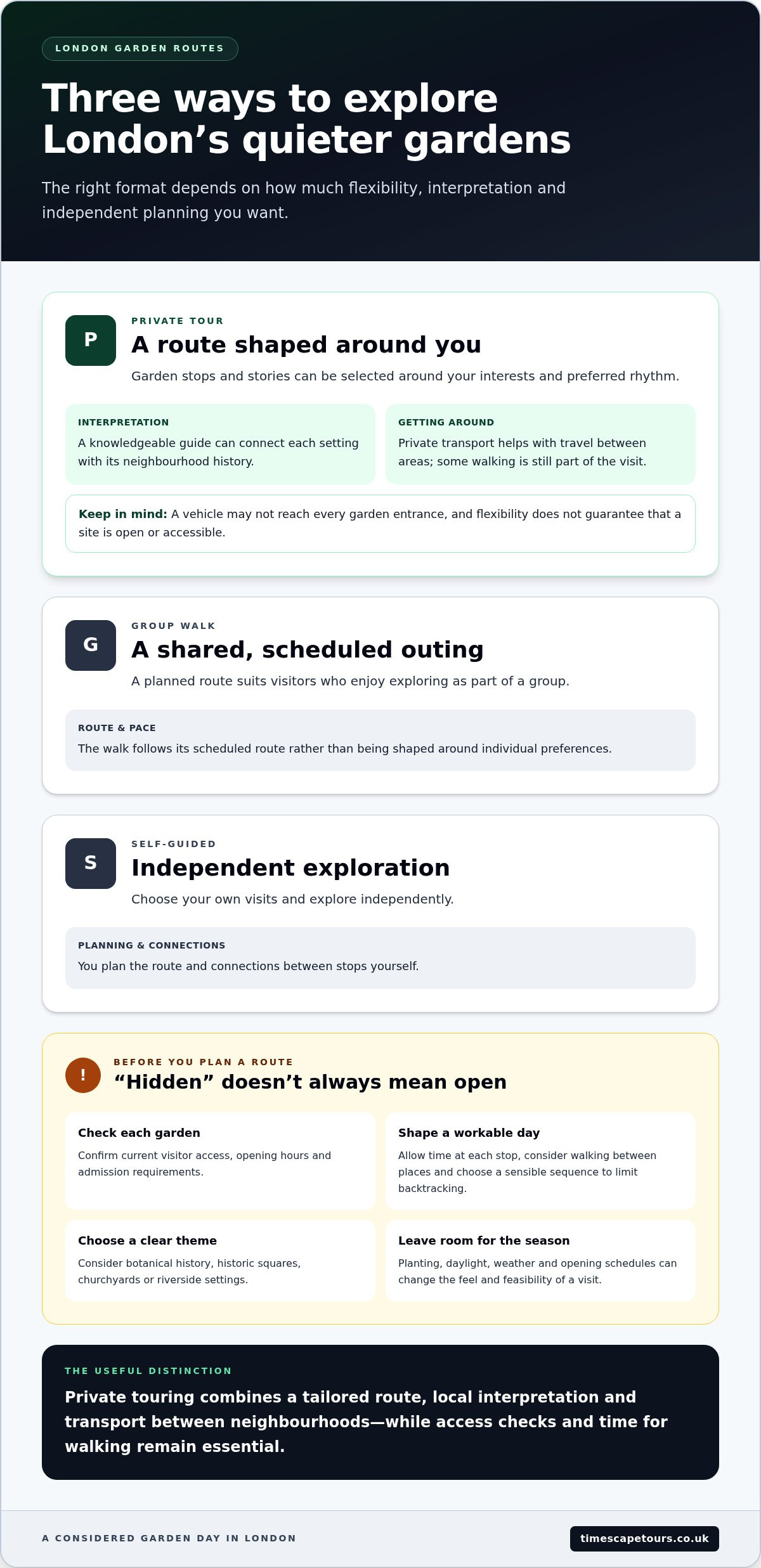
A knowledgeable guide can connect a garden’s setting with the wider history of its neighbourhood, turning a quiet stop into a richer encounter with London. Private transport makes it easier to travel between areas without planning every connection yourself, though a vehicle may not reach every garden entrance and some walking is part of the visit.
Compared with a fixed-route group walk, a private driver-guide itinerary can be planned around your interests and preferred rhythm. That flexibility helps you shape the day, but does not guarantee that every site will be open or accessible. Choose places that fit your plans, check their current visitor arrangements and leave time to enjoy each stop without rushing.
Which London gardens and stories could shape your private route?
The right garden stops depend on what you hope to notice. A plant-focused visit might centre on botanical history; a route through historic squares can foreground architecture and residential life; churchyards invite quieter reflection, while riverside settings bring the city’s relationship with water into view. These themes can be combined, but choosing a clear emphasis helps a day feel considered rather than like a checklist.
A memorable garden route brings together places that suit your interests, the season’s character and the time available for exploring. You might linger over plant collections, take in the setting of a historic square or allow more time to walk between a garden and nearby landmarks. Choosing a sensible sequence also helps limit backtracking across London.
Botanical history at Chelsea Physic Garden
Chelsea Physic Garden offers a botanical-history perspective, where plants themselves can become the focus of a visit. A collection invites closer observation: how plants differ, how they are arranged and what their cultivation can reveal about people’s relationship with the natural world. This kind of stop can appeal to visitors who enjoy asking questions as they wander, as much as to those who come for the visual setting.
Opening times, admission requirements and visitor arrangements can change, so check the garden’s current information before planning a visit. Allow time for the visit itself, then build the rest of the route around the hours available rather than assuming every stop follows the same schedule.
Historic squares, churchyards and tucked-away settings
Lincoln’s Inn Fields offers a different atmosphere from the more enclosed setting of Temple Gardens, while St Dunstan in the East provides a garden-like historic space amid remnants of an earlier city. These contrasts can suggest different stories, from the form of a London square to the way a former religious setting now invites visitors to pause. A small selection of contrasting places can give a route variety without turning the day into a long list of stops.
Access isn’t the same everywhere. Some squares and gardens are publicly accessible, while others have restricted entry or seasonal arrangements. Don’t assume that a place described as “hidden” is open to everyone. Check current visitor information for each intended stop, including opening hours and admission requirements, then use those details to plan the sequence.
Season changes the experience, too. Planting, daylight, weather and opening schedules all affect what makes sense on a particular day. A route planned around summer flowers may feel quite different in another season, when architecture, sheltered corners or historical context take precedence. Keeping the selection flexible helps if conditions or access affect a particular stop.
With a bespoke private driver-guided itinerary, Timescape Tours can connect garden stops around your interests, with transport between neighbourhoods and a knowledgeable guide to bring out the stories of each setting. If you’re considering a private tour of london's secret gardens, bespoke private touring offers a way to shape a garden-led day around the places and pace that appeal to you.
Private garden tour or fixed itinerary: which London experience fits you?
The best format depends on how you like to explore. A scheduled walk suits someone who enjoys a shared outing and a planned route; self-guided visits offer independence, while private driver-guided touring lets you shape the day around personal interests. Consider how much walking, interpretation and control over timing you want before deciding whether a private tour of london's secret gardens fits your London plans.
When a private driver-guide suits your London plans
A private driver-guide suits you if you want to connect gardens in different parts of London without making every transfer part of the day’s planning. A knowledgeable guide brings historical context to each setting, and the itinerary can be built around what interests you, from garden design to local stories. Timescape Tours’ bespoke touring approach makes a garden-led day a personal itinerary rather than a fixed sequence of stops.
Private touring can also work well if you prefer a measured day, with fewer stops or more time at places that capture your attention. Plan around each site’s access arrangements and the walking involved. Private transport can connect neighbourhoods, but it does not remove every walk or guarantee access to a garden.
When a walking or self-guided visit may be preferable
A scheduled walk can work well if you enjoy discovering a neighbourhood on foot with others and are content to follow a set route and timing. Independent exploration may suit you better if you like researching places in advance, choosing stops spontaneously and deciding how long to stay. Your walking tolerance and preferred use of public transport are practical considerations, not small details.
If a garden-focused day feels too specialised, give it a wider theme: pair planting with architecture, churchyards with nearby historic streets, or green spaces with riverside scenery. Gardens can remain at the heart of the experience while the stories and neighbourhoods around them add variety. For travellers drawn to a tailored route with private transport, bespoke private touring can centre the day on those interests.
How to plan a comfortable London secret-gardens day
A rewarding garden day is about more than a list of places. Planning helps you choose stops that reflect your interests, account for access and movement, and leave enough breathing room to enjoy each setting. Use these five steps to shape a private tour of london's secret gardens around a comfortable, realistic rhythm.
Choose a theme, season and comfortable pace
Start with what you most want to discover: botanical collections, garden architecture, quiet corners or the history of a place. Spring and summer can bring different displays from colder months, but conditions vary, so treat seasonal flowers as a possibility rather than a promise. Then consider how much time you want for looking around, pausing and travelling between stops. A shorter shortlist can feel more rewarding than a packed route.
Choose interests: Pick a main theme, or combine two that naturally complement each other, such as garden history and architecture.
Shortlist sites: Select places that suit that theme and sit sensibly together, rather than adding stops just to make the itinerary longer.
Check access: Review current opening schedules, admission arrangements and restrictions for every garden, especially close to your visit.
Set the pace: Allow time on foot, for rests and for unhurried visits, taking your walking tolerance and mobility preferences into account.
Shape transfers: Plan how you’ll travel between areas, remembering that private transport can connect neighbourhoods but may not reach every garden entrance.
Check access and make the day work smoothly
Access can vary from one garden to another, and a space that looks inviting from the street may have specific opening times or visitor conditions. Check the latest information before finalising your route, including admission arrangements and whether entry is restricted on particular days or at certain times. For a garden-led day, a change to one stop can affect the sequence of the others, so it helps to have a nearby alternative in mind.
Think about the ground as well as the map. Paths may be uneven, and seating may not be available wherever you’d like to pause. Comfortable footwear, weather-appropriate layers and water can help during a day that moves between outdoor settings. If you prefer shorter walks or regular breaks, account for that from the outset. Realistic expectations help the day feel leisurely rather than hurried.
With a bespoke private itinerary, Timescape Tours can plan the choice of stops and transfers around your interests and preferred rhythm. Explore a bespoke private tour with Timescape Tours and begin shaping a London garden day that feels personal, considered and comfortable.
Shape a private London garden tour around your interests
A garden-led day needn’t follow a pre-set sequence. With Timescape Tours’ bespoke private driver-guided touring, you can begin with the gardens and stories that appeal to you, then shape a coherent route around them. A knowledgeable guide brings historical interpretation to the places you visit, while private transport connects the day’s settings. The aim is not to fit in as many stops as possible, but to create a day that feels personal and comfortably paced.
Turn your garden interests into a tailored itinerary
Start by considering the garden styles you enjoy, the historical subjects that catch your attention and how you prefer to spend a day. You might be drawn to botanical collections, the design of London’s squares, secluded churchyards or the history of a particular neighbourhood. Those preferences help shape a route with a clear thread, rather than a collection of unrelated stops.
Nearby architecture and cultural context can add another layer without taking the day away from its garden focus. A visit might be complemented by time to notice the surrounding streets or discuss how the area has changed. The route can be planned around current opening arrangements and your priorities, so the choice of stops reflects what matters most to you.
Share your interests: Name the garden styles, plants, periods or local stories you’d most like to explore.
Describe your preferred pace: Say whether you’d rather linger at a few places or include more variety, with breaks and walking comfort in mind.
Build a connecting theme: Link garden visits with nearby architecture or cultural history where it adds to the experience.
Keep the route responsive: Let opening schedules and access arrangements inform the final sequence of stops.
What to expect from a private driver-guide day
Unlike travelling as part of a coach group, a private driver-guide day is planned around your party’s interests, bringing private transport and historical interpretation together. Timescape Tours uses vehicles such as black cabs and executive saloons. Your guide can connect each garden with the stories of its surroundings, while the route is shaped to allow for a considered pace.
Private touring doesn’t mean every entrance is reached by vehicle or that every garden will be open on the day. Some walking remains part of exploring, and access depends on each site’s arrangements. Taking these details into account while planning helps set comfortable expectations and leaves room for looking closely, pausing and following a story that interests you.
If a private tour of london's secret gardens sounds like the right way to explore, share the places and themes you’re drawn to and plan a bespoke London tour with Timescape Tours.
Begin shaping your own garden day
Begin by deciding what you’d most like to remember. Perhaps it’s a quiet pause amid the city, a closer look at a favourite period of garden design, or the pleasure of discovering how a green space belongs to its neighbourhood. That preference can become the thread that gives your day its character.
A private tour of london's secret gardens is an invitation to experience London from a more personal perspective, with room for curiosity and time to appreciate details that might otherwise pass unnoticed. You don’t need a complete itinerary in mind before you begin. A sense of what interests you is a good place to start, and the route can take shape from there.
Plan a bespoke private tour of London’s secret gardens with Timescape Tours and start imagining a day that feels distinctly yours. Share the settings and stories you’re interested in, and shape a thoughtful garden day in London.
Frequently Asked Questions
Can you visit secret gardens in London?
Yes, London has tucked-away gardens and green spaces, but access depends on the individual site. Some welcome visitors during published opening hours, while others may be restricted or open only at certain times of year. Before building a private tour of london's secret gardens, make a shortlist and check each place’s current visitor information. This helps you avoid planning around a garden that isn’t open on your chosen day.
What gardens might feature on a private tour of London’s secret gardens?
Possible examples include Chelsea Physic Garden, Lincoln’s Inn Fields, Temple Gardens and St Dunstan in the East. They offer contrasting settings, from botanical interest to historic green spaces within the city. Treat these as ideas for shaping the day: whether they fit depends on access, opening arrangements and the experience you want. Grouping stops by area also helps avoid a route that feels scattered.
Is a private London garden tour suitable for visitors who do not want to walk all day?
It can be planned with walking comfort in mind, though visiting gardens still means spending time on foot. Before setting the route, think about the kind of walking that feels manageable, whether you prefer frequent pauses and whether steps or uneven surfaces are a concern. Share these preferences while planning and review access details for each site. A vehicle can link neighbourhoods, but it may not reach every garden entrance.
When is the best time of year for a London secret-gardens tour?
The best time depends on your priorities and the opening schedule of the gardens you hope to visit. Spring and summer can bring changing plant displays, while another season may appeal more for its quieter atmosphere or architectural details. Don’t plan around a particular flower being in bloom without checking current conditions. Once you have possible dates, compare them with each garden’s visitor information before settling on a route.
What should I wear for a garden tour in London?
Choose comfortable walking shoes with a sole that grips well, as garden paths can be wet or uneven. Layers make it easier to adapt as the weather changes, and a light rain layer or compact umbrella can be useful outdoors. Carry only what you need to keep your bag comfortable between stops. Practical clothing lets you focus on the gardens rather than the conditions.
Can a private garden tour include historical sights as well as gardens?
Yes, a garden-led day can also include nearby architecture, local history or cultural settings, depending on your interests and the route. A guide can explain how a green space relates to its surrounding streets, buildings or memorials, giving the visit a broader context. Timescape Tours can shape a bespoke private driver-guided itinerary around those interests, while taking account of site access and your preferred pace.



Comments