


A Private Tour of London's Rock History by Music Interest

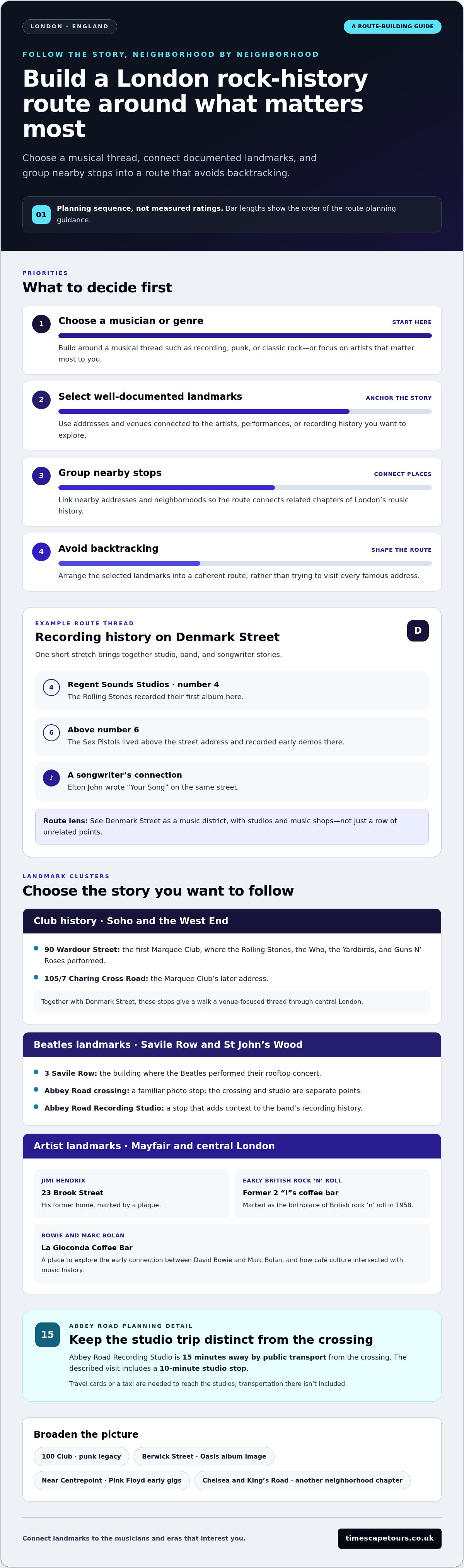
For travelers in the United States planning a visit to London, England, the city’s rock history is best explored by neighborhood, where streets connect landmark venues, recording sites, and musicians’ homes. A private tour of London’s rock and roll history can include the former 2 “I”s coffee bar, marked as the birthplace of British rock ’n’ roll in 1958, the Beatles’ rooftop concert building at 3 Savile Row, and Jimi Hendrix’s former home at 23 Brook Street. The Marquee Club’s later address, 105/7 Charing Cross Road, adds another essential stop.
Abbey Road is an iconic photo stop in London, but it is only one part of the city’s rock and roll story. From Soho’s clubs to Denmark Street’s studios, different neighborhoods reflect distinct eras, artists, and sounds.
This guide highlights landmarks to prioritize and ways to shape a route around the musicians or genres that matter most to you. You’ll see how London’s neighborhoods connect a wider story, from punk venues and Britpop imagery to places associated with Bowie, Bolan, and the Stones. With a thoughtful itinerary, the city becomes more than a list of famous addresses: it offers a vivid portrait of the people and scenes that changed popular music.
Table of Contents
What are the best rock music landmarks in London?
The landmarks below are in London, England, not London, United States. For US travelers planning a visit to the British capital, a route can connect music history across Soho, Mayfair, and St John’s Wood.
Artists and Rock Music Landmarks
At 23 Brook Street in London, England, a plaque marks Jimi Hendrix’s former home. The first Marquee Club stood at 90 Wardour Street, where the Rolling Stones, the Who, the Yardbirds, and Guns N’ Roses performed. Its later address was 105/7 Charing Cross Road. These sites help trace the venues and neighborhoods that shaped British rock.
For Bowie, La Gioconda Coffee Bar links his early London story with Marc Bolan. Eric Clapton offers another musician-led thread, while the former Marquee Club locations connect the Who and other performers with the city’s club history. Prioritize the artists you most want to explore rather than trying to visit every famous address.
Abbey Road and Beatles Sites
At 3 Savile Row in London, England, the Beatles performed their rooftop concert. In St John’s Wood, the Abbey Road crossing is a familiar photo stop, while Abbey Road Recording Studio adds context to the band’s recording history. The studio is 15 minutes away by public transport.
A route can include a photo stop at the crossing and a 10-minute stop at Abbey Road Studios. Travel cards or a taxi are needed to reach the studios, and transportation there isn’t included. Treat the crossing and studio stop as separate points when planning travel across London.
How do private rock history tours compare with London’s group music tours? A private route can focus on your preferred musicians and give your party a shared itinerary. The described private tour accommodates 1 to 10 people.
What is included in a private Beatles and rock history tour of London? Stops can include the Beatles’ rooftop concert building at 3 Savile Row, an Abbey Road crossing photo stop, and a 10-minute stop at Abbey Road Studios. Other London landmarks connect stories associated with Hendrix, Bowie, Clapton, and the Who.
How long do London’s private rock and roll tours last? The private London rock music history tour lasts 3 hours and starts at 1:30 pm.
Where do London rock and roll tours start, and do they include hotel pickup? The listed meeting point is Millennium Hotel and Conference Centre Gloucester London, 4-18 Harrington Gardens, South Kensington; another suggested meeting point is near the Swiss Clock and the M&M shop in Leicester Square. These are London, England locations, and the described arrangement gives meeting points rather than hotel pickup.
Are London’s private music tours accessible for children and people with mobility needs? The tour is listed as wheelchair accessible, and infants must sit on an adult’s lap. Transportation is by comfortable, air-conditioned bus.
Customizing the route by musician or music genre
The landmarks in this guide are in London, England, not London, United States. For a visit to the British capital, choose a musical thread first, then connect the relevant neighborhoods and addresses into a coherent route.
Denmark Street Music Stops
Denmark Street in London, England, brings recording stories together on one short stretch. The Rolling Stones recorded their first album at Regent Sounds Studios, number 4, while the Sex Pistols lived above number 6 and recorded early demos there. Elton John wrote “Your Song” on the same street, adding a songwriter’s story to the neighborhood’s studio history.
See Denmark Street as a working music district, not simply a row of unrelated points. Its studios and music shops help explain how musicians recorded, found equipment, and built creative connections in central London. A walking route can pause at documented addresses, then set those stories beside nearby venues without treating every storefront as a landmark.
Chelsea and King's Road Music History
Chelsea and King’s Road offer a change of pace from Denmark Street’s concentrated recording history. Chelsea is among the neighborhoods featured on London rock-history tours, broadening an itinerary beyond Soho and the West End. For US travelers, these locations are in London, England.
Use this neighborhood section to shape a route around the eras and artists that interest you, without assigning unsupported music claims to individual streets. Pair Chelsea with documented music landmarks elsewhere in the city, and let the contrast between areas add texture to the journey.
Soho and the West End make a useful base for a self-guided rock-music walk through central London, England. Start on Denmark Street, then continue toward the former Marquee Club locations: the original site at 90 Wardour Street and its later address at 105/7 Charing Cross Road. Those stops give the walk a clear venue-focused thread and help distinguish one chapter of the club’s story from another.
To plan a private tour of London’s rock and roll history, choose a central theme, such as recording, punk, or classic rock. Select well-documented landmarks and group nearby stops to avoid backtracking. A private tour of London’s rock and roll history can focus on the musicians and neighborhoods that matter to you, while a self-guided walk lets you set your own pace.
A recording-focused itinerary might connect Denmark Street with Soho’s former venues; a wider route can bring Chelsea into the picture. The goal is a musical narrative with purposeful stops, not the longest possible checklist. If you’d like a tailored London itinerary, explore private touring options.
Bowie and Marc Bolan at La Gioconda Coffee Bar
La Gioconda Coffee Bar belongs on a London music-history route for a meeting, not a concert. David Bowie and Marc Bolan met there before either became famous. That encounter brings two distinctive careers into one modest setting and offers a quieter counterpoint to famous stages, studios, and album artwork. The café remained in operation until 2014, giving the story a clear marker in its later history.
The meeting at La Gioconda Coffee Bar brings Bowie and Bolan together before their public identities took shape. Rather than treating the café as a shrine to one star, consider how London brought musicians into contact. Their later reputations make the encounter compelling, but the key point is simple: they met at La Gioconda before fame.
On a walking tour, use this stop as a pause for context. Start with the café’s name, then connect the encounter to London’s broader music story and the artists who crossed paths there. Keep the distinction clear: La Gioconda is associated with a meeting, while the former Marquee Club is associated with performances. Each landmark therefore has its own meaning.
The café’s history also calls for careful wording. It was still operating as a café until 2014, but that fact alone doesn’t establish its present use or visitor access. Treat La Gioconda as a historical location to interpret from its documented connection, not as a promise of an open café experience. This keeps the stop grounded and helps set realistic expectations before travel.
To bring the story to life, identify La Gioconda, place Bowie and Bolan at the meeting point, then follow the musical paths their names evoke. Compare their shared early London setting with landmarks tied to the Rolling Stones or the Beatles, without assuming all these artists belonged to one scene. The value lies in seeing the city as a network of encounters, not a single genre map.
Before booking a private route, decide whether this meeting is a central interest or one scene within a wider itinerary. If Bowie and Bolan are your focus, a knowledgeable guide can explain why their encounter matters to your chosen music history. If you’re following several artists, place La Gioconda between other relevant stops so its story connects naturally without overshadowing the route.
That approach turns one street-level landmark into a thoughtful point of connection. La Gioconda adds a personal encounter to London’s rock history: Bowie and Bolan met there before fame, and the café remained open until 2014. Those details are enough to anchor the stop while leaving room to explore how each musician’s later work shaped the story listeners bring to the site.
The Bag o Nails and Jimi Hendrix
The Bag o’ Nails adds a personal encounter to London’s rock stories: Paul McCartney met Linda there. This gives the place a different role from a recording studio or performance landmark. Rather than focusing on a song or stage, it connects the city’s music history with a meeting between two people who later became widely known.
Pair that story with Jimi Hendrix’s former London home at 23 Brook Street, where a plaque marks the house as a tour stop. The two locations invite different questions. At the Bag o’ Nails, consider the personal connections behind musical lives; at Brook Street, reflect on the place Hendrix called home. Together, they broaden a route beyond famous recordings.
Keep the distinctions clear as you explore. The documented Bag o’ Nails connection is McCartney meeting Linda, while the Brook Street plaque identifies Hendrix’s former home. Neither point needs an embellished anecdote to earn a place in a thoughtful itinerary. A guide can set each story in context and connect these landmarks to the wider British rock narrative.
For a focused walk or private route, begin by deciding which story matters most to you. If you’re following McCartney, use the Bag o’ Nails meeting as a personal point in the Beatles’ London story. If Hendrix is your priority, make 23 Brook Street the anchor and consider how a home address differs from a venue or studio. That simple choice gives the route a clear thread.
These stops balance familiar names with different kinds of landmarks. The Beatles’ story at the Bag o’ Nails centers on Paul and Linda’s meeting; Hendrix’s Brook Street connection centers on his London home. A route can place these stories alongside other music addresses while preserving each stop’s meaning. That makes the experience more than a checklist of celebrity locations.
As you plan, note the names and stories you want to hear, then group the relevant stops into a coherent sequence. The Bag o’ Nails can represent a personal connection; 23 Brook Street offers a marked home landmark. Their value lies in the contrast. Together, they show how London’s rock history includes intimate encounters as well as the public stages and recordings associated with classic British music.
Rock and pop history by London neighborhood
London’s music history becomes clearer when landmarks are grouped by neighborhood rather than treated as isolated photo stops. Soho, Carnaby Street, Berwick Street, and the area near Centrepoint each offer a distinct thread, from punk and club culture to album imagery and early psychedelic performances.
How much do private rock history tours in London cost? Price depends on the route, duration, transport, and group requirements, and is provided after a quote request. A route focused on central venues differs from one that adds neighborhoods such as Chelsea, Kensington, Notting Hill, and St John’s Wood.
Soho gives visitors a particularly vivid sequence of famous music places. The 100 Club first opened in 1942, then became associated with the first punk festival, featuring early performances by the Sex Pistols, the Damned, and the Clash. Rather than simply naming the venue, use it to explore how punk’s performance culture became part of London’s musical identity.
Nearby Carnaby Street adds another layer. A plaque at 52 Carnaby Street honors Don Arden and the Small Faces, linking a specific address with people who shaped the era’s music business and sound. Include this stop when you want the route to consider the wider ecosystem around bands, not only concert halls and recording rooms.
Berwick Street offers a different kind of landmark: Oasis used it as the image for their second album, What’s the Story (Morning Glory). The street connects a familiar album cover with the city around it. It’s a useful stop for Britpop fans and anyone interested in how London streets become part of popular music’s visual memory.
Near Centrepoint, the former UFO club adds an earlier chapter. Pink Floyd played early gigs there, making the location relevant to London’s psychedelic music history. Set beside Soho’s punk story, it shows how nearby central areas can represent different sounds and generations without forcing them into one narrative.
Build a neighborhood route by choosing a musical era first, then pairing landmarks that deepen that story. For punk, connect the 100 Club with Soho’s wider club history; for Britpop, include Berwick Street. Add Carnaby Street for the Small Faces connection, or the former UFO club for Pink Floyd’s early performances. This approach gives each stop a purpose and keeps travel between stories coherent.
To explore London’s musical neighborhoods through a tailored itinerary, plan a private London route.
Pink Floyd played early gigs at the former UFO club near Centrepoint in London. For visitors following that thread, the stop offers a point of comparison with Soho’s punk landmarks and the Small Faces connection at Carnaby Street. Exploring how different musical stories occupy nearby neighborhoods connects the itinerary without suggesting that every venue represents the same moment or sound. It also gives the route a clear reason to move between places, rather than treating each address as a standalone photograph.
Timescape Tours: Windsor Castle Tour
Timescape Tours offers a Windsor Castle Tour for travelers who want to pair London’s musical heritage with a day exploring royal history. For a closer look at the capital’s broader landmarks, the London Panoramic Tour is a natural complement to a music-focused visit.
If you’re planning more time in England, Stonehenge and Bath and The Cotswolds offer further ways to shape your itinerary around history and landscape. Choose the experience that suits your interests and travel plans, then get in touch with Timescape Tours to discuss your next outing.
Choose Your Next London Story
The most memorable route begins with a choice: follow one artist closely, trace a genre across neighborhoods, or let contrasting musical stories shape the day. A private tour of London’s rock and roll history gives that choice room to guide the experience, so the places you visit reflect what you’re genuinely curious about.
When you’re ready to plan another chapter of your stay, Timescape Tours offers a Windsor Castle Tour, a Stonehenge and Bath Tour, and The Cotswolds Tour. Each opens a different window on England, from royal heritage to ancient sites and countryside landscapes. Choose the outing that suits your interests, then contact Timescape Tours to plan your route.
Let your curiosity set the direction, and enjoy discovering London and England at your own pace.
Frequently Asked Questions
Which London rock music landmarks do private tours visit?
Private routes can bring together landmarks across London, with stops selected around your musical interests. For a punk-focused visit, consider the 100 Club and its early festival history; for a broader itinerary, connect sites in Chelsea, Kensington, Notting Hill, and St John’s Wood. Choose a few places that tell a connected story, rather than trying to cover every famous address in one outing.
Do London's private rock and roll tours include Abbey Road and a studio visit?
They can include a photo stop at the Abbey Road crossing and a 10-minute stop at Abbey Road Studios. The studio is 15 minutes away by public transport, and reaching it requires travel cards or a taxi, which aren’t included in the tour. Plan these as distinct parts of your itinerary: the crossing offers the classic Beatles photo, while the studio stop adds a separate landmark.
Comments