


Winston Churchill’s Chartwell: A Private Tour Guide from London
- Mark Cairns
- Mar 30
- 13 min read

Updated: Apr 4
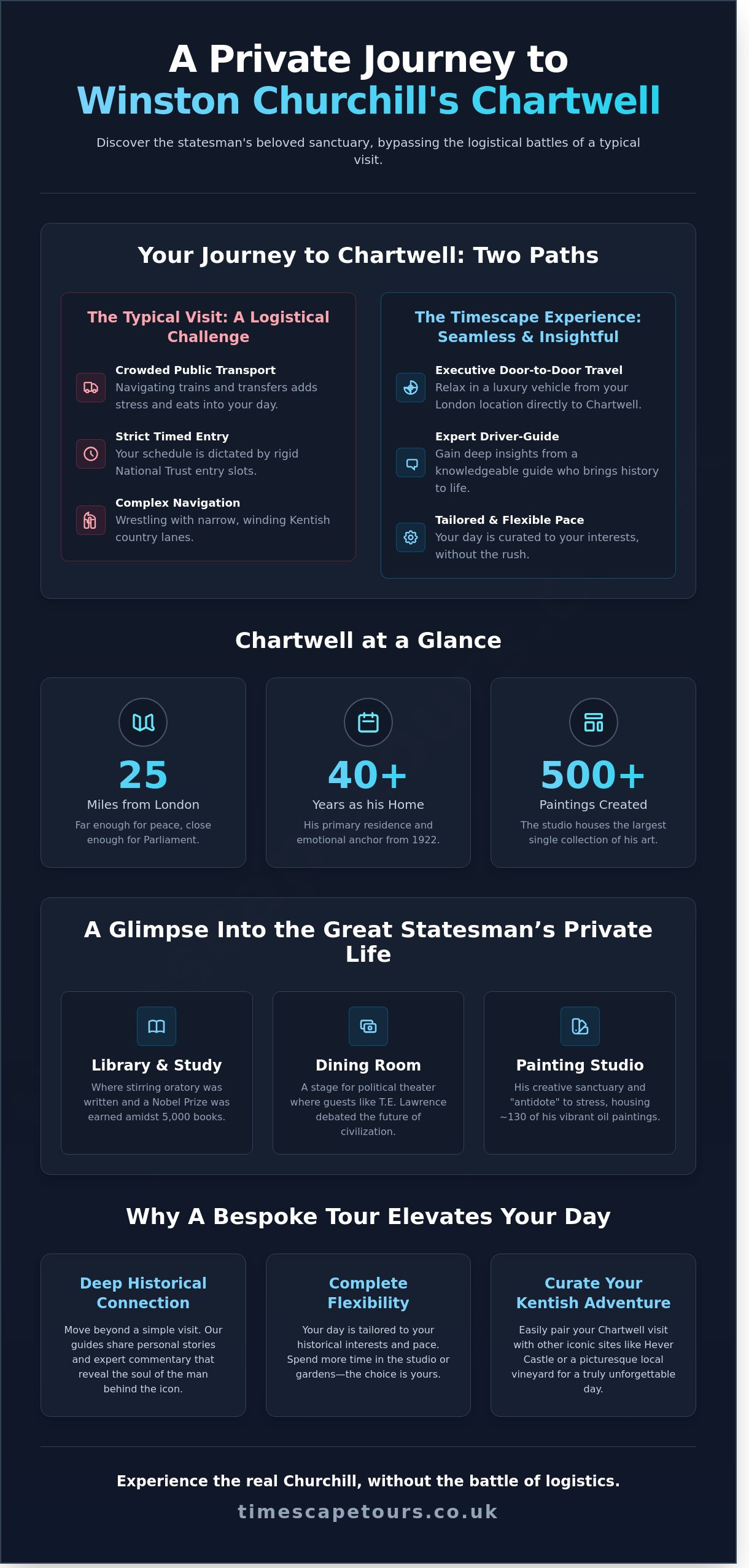
You haven't truly met Britain's greatest wartime leader until you've stood where he stood, overlooking the rolling Weald of Kent, far from the frantic energy of the Cabinet War Rooms. Most visitors recognize the public face of the "British Bulldog," yet the logistics of reaching his private sanctuary, located 25 miles from central London, often feel like a battle of their own. Navigating the narrow, winding lanes of Kent or timing a strict National Trust entry slot can quickly drain the historical magic from your day. We understand that you seek more than a mere commute; you desire a deep connection to the man who spent 40 years cultivating this "island hideaway."
We've designed a seamless, bespoke journey to winston churchill chartwell that replaces crowded trains with the quiet luxury of an executive-class vehicle. You'll gain deep historical insights from a knowledgeable driver-guide who brings the "real" Churchill to life through personal stories and expert commentary. This guide outlines how your private tour will bypass the typical travel pains, offering you an intimate, door-to-door experience that reveals the soul of an icon through his beloved family home and the 500 paintings he created within its walls.
Key Takeaways
Explore the intimate sanctuary where the Great Statesman wrote history and found inspiration amidst the rolling hills of the Kent Downs.
Discover the physical legacy of Churchill’s "man of the soil" persona, from the lakes he excavated to the garden walls he built with his own hands.
Gain essential logistical insights for your journey to Winston Churchill’s Chartwell, including travel times from London and advice on securing timed entry tickets.
Learn how a bespoke driver-guide can elevate your experience by tailoring the day’s pace and itinerary to your personal historical interests.
Find out how to pair your private tour with iconic nearby sites like Hever Castle or a visit to a picturesque Kentish vineyard for a truly curated adventure.
Table of Contents Discovering Chartwell: Sir Winston Churchill’s Beloved Kent Retreat Inside the House and Studio: A Glimpse into the Great Statesman’s Private Life The Gardens and Estate: Churchill’s 'Man of the Soil' Persona Planning Your Visit from London: Transport, Timing, and Practical Tips The Timescape Experience: A Bespoke Churchill Tour
Discovering Chartwell: Sir Winston Churchill’s Beloved Kent Retreat
Chartwell isn't just a house; it's a window into the soul of Britain's most iconic statesman. Sir Winston Churchill purchased this estate in 1922, and it remained his primary residence and emotional anchor until his passing in 1965. Nestled within the rolling greenery of the Kent Downs, the property served as his ultimate sanctuary and a constant source of creative inspiration. For those looking to escape the bustle of the capital, a private tour to winston churchill chartwell represents the quintessential historical day trip into the 'Garden of England.'
The National Trust now preserves the house with meticulous care, ensuring the interiors look exactly as they did during the 1930s. It feels as though the family has simply stepped out for a walk in the gardens, leaving their books and cigars behind. Visitors can explore several evocative spaces:
The library and study where Churchill crafted his most stirring oratory.
The dining room, permanently set as if for a lively 1930s lunch party.
The garden studio, which houses the largest collection of his vibrant oil paintings.
Why Churchill Chose This 'Island Hideaway'
Churchill was captivated by the panoramic views over the Weald of Kent when he first visited the site in September 1922. He famously remarked that he bought the house for the view, and he wasn't exaggerating. During his 'Wilderness Years' from 1929 to 1939, when his political career appeared to be in terminal decline, Chartwell became his fortress. The location was strategic. It sat 25 miles from Westminster, which was close enough for a swift drive to Parliament but far enough to provide the peace required for his prolific writing and bricklaying hobbies.
A Legacy Preserved by the National Trust
The survival of the estate is a testament to the loyalty Churchill inspired in his peers. In 1946, a group of his closest friends purchased the house to ensure he could remain there for the rest of his life despite his financial struggles. It opened to the public in 1966, just one year after his death, and became an immediate site of global pilgrimage. The 2026 visitor experience is particularly significant. This year marks the 60th anniversary of the public opening, featuring curated exhibitions that highlight the domestic life of the Churchill family in ways previous seasons haven't explored. It remains a bespoke highlight for any discerning traveler visiting winston churchill chartwell today.
Inside the House and Studio: A Glimpse into the Great Statesman’s Private Life
Stepping through the front door of winston churchill chartwell feels less like entering a formal museum and more like arriving for a weekend visit. The rooms remain arranged exactly as they were when Clementine and Winston lived here. Following his death in 1965, the house was gifted to the National Trust with the proviso that it stay as a lived-in family home. You’ll see his iconic velvet "siren suits" and half-smoked cigars resting in ashtrays. It’s a rare, intimate look at the man behind the "V for Victory" sign, revealing the personal passions that fueled his public resolve.
Among his personal effects, Churchill's choice of timepieces also spoke to his appreciation for enduring quality and craftsmanship. He was a known connoisseur of fine watches, and this passion for horological excellence is shared by collectors today. For those interested in exploring the heritage of iconic brands, Luxury of Watches offers a curated collection of classic and modern timepieces.
The Drawing Room and Library: Where History Happened
The library holds a staggering 5,000 volumes, reflecting a polymathic mind that never rested. At the heart of the house sits the mahogany desk where he wrote his most famous speeches and the historical volumes that earned him the Nobel Prize for Literature in 1953. Nearby, the dining room functioned as a stage for political theater. Between 1924 and the late 1950s, figures like T.E. Lawrence and Charlie Chaplin sat at this table. They didn’t just eat; they debated the very future of Western civilization while Churchill held court with champagne and wit.
His mastery of the language, recognized by the Nobel Prize, continues to be a subject of study for English learners globally. For those inspired by such powerful communication, dedicated language schools like English Explorer offer a path to similar eloquence.
The Painting Studio: Churchill’s Creative Sanctuary
A short walk through the gardens leads to the studio, home to the largest collection of his artwork in the world. You’ll find approximately 130 of his paintings here, ranging from Mediterranean landscapes to vibrant still lifes. Painting was his essential "antidote" to the stresses of the Admiralty and the War Office. His easel remains standing with brushes and a palette of oils, looking as though he might return at any moment. Seeing these works reveals a sensitive, artistic side often obscured by his rugged public persona. If you’d like to string together a visit to winston churchill chartwell with other historic Kentish estates, our driver-guides can curate that perfect day for you.
The Gardens and Estate: Churchill’s 'Man of the Soil' Persona
Beyond the heavy responsibilities of the Admiralty or the Cabinet, Winston Churchill Chartwell found a different kind of peace in the mud and mortar of his Kentish home. He often remarked that he lived "from hand to mouth" on his writing, yet he spent his physical energy reshaping the 80-acre estate with an intensity that matched his political life. You'll see his fingerprints on the very landscape. He wasn't a gentleman who merely pointed from a terrace; he was a man who donned overalls and got to work, finding solace in the tangible progress of a well-laid course of bricks or a newly cleared pond.
The Kitchen Garden and the Famous Brick Wall
The red brick walls surrounding the productive kitchen garden are perhaps the most famous testament to his hobby. In 1928, Churchill joined the Amalgamated Union of Building Trade Workers, and he spent many afternoons laying up to 200 bricks a day. Today, the garden still produces heirloom vegetables and fruits that would've graced the Churchill family table. Nearby, the Golden Rose Walk offers a softer perspective. This 32-metre long pergola was a golden wedding anniversary gift from his children in 1958, blooming with a variety of yellow roses that reach their peak in June. Just a short stroll away sits the Marycot, a brick playhouse Churchill built for his youngest daughter, Mary, in 1935. It remains a perfectly scaled miniature home, complete with its own tiny garden and fireplace.
The Lakes and the Black Swans
Churchill's fascination with water led him to design a series of dams and lakes that descend through the valley. He often sat by the fish pond, feeding the golden orfe or watching the iconic black swans. These elegant birds were a 1954 gift from the Australian government and have become a permanent fixture of the estate. These waterside locations served as his "thinking spots" where he contemplated the rising threat of Nazi Germany during his "wilderness years" in the 1930s. If we wander the trails across the estate, you'll reach the high points of the Weald. From here, the view stretches across the Kentish countryside, a sight Churchill claimed he loved so much he bought the house for it in 1922. The seasonal changes here are spectacular, from the spring bluebells to the deep autumnal golds of the beech trees.
The Brick Wall: Look for the uneven mortar in places, a sign of the Great Man's own handiwork.
The Black Swans: Descendants of the original pair gifted by Australia still glide on the lower lake.
The Marycot: A charming example of Churchill's skill as a builder, designed specifically for a child's imagination.
As your driver-guide, I'll ensure we take the time to walk these paths at your pace. It's a bespoke experience that allows you to stand exactly where Winston stood, looking out over the same valley that inspired his most famous speeches.
Planning Your Visit from London: Transport, Timing, and Practical Tips
Chartwell sits approximately 25 miles south of Central London, nestled within the undulating landscape of the Kentish Weald. While the distance seems modest, the journey typically requires 60 to 90 minutes depending on your departure point. Winding through the narrow, high-hedged lanes of Kent is an essential prelude to the experience. These ancient tracks provided the same sense of sanctuary for the Churchill family as they do for visitors today. To see winston churchill chartwell in its best light, you should aim to arrive by 10:00 AM, allowing a full day to explore the house, the studio, and the extensive gardens.
Timing your visit is a matter of personal preference. The gardens reach their peak in June when the rose garden, designed by Lady Clementine, is in full bloom. However, the house feels most intimate during the quieter autumn months of October and November. During these cooler days, the golden light across the Weald mirrors the atmosphere of Churchill’s own late-season painting sessions. Always remember that the National Trust operates a strict timed entry system for the house itself to preserve the delicate interiors.
Private Driver-Guide vs. Public Transport
Reaching this hillside retreat via public transport involves a 35-minute train journey from London Bridge to Sevenoaks, followed by a 15-minute taxi ride. Taxis at the station are often scarce during peak tourist windows, and the return journey can be notoriously difficult to coordinate. Choosing a door-to-door service in an executive vehicle eliminates these logistical hurdles. A professional driver-guide begins the storytelling long before you reach the gates, providing historical context and personal anecdotes that a train carriage simply cannot offer. You can book a bespoke private tour to ensure your travel is as sophisticated as the destination itself.
Practical Details for Your 2026 Visit
For the 2026 season, adult tickets are projected to be approximately £22.00, though National Trust members enter for free. Booking several weeks in advance is vital because house slots frequently sell out, especially on weekends. The site presents certain challenges for those with limited mobility; the house and gardens are situated on a steep hillside with uneven paths. A dedicated buggy service usually operates from the visitor centre to the house entrance for those who need assistance.
Dining: The Landemare Café on-site serves seasonal British fare, named after Churchill's long-serving cook, Georgina Landemare.
Local Pubs: For a traditional lunch, the 16th-century Grasshopper on the Green in nearby Westerham is a five-minute drive away.
The Studio: Ensure you check the daily opening times for the studio, as it occasionally closes earlier than the main house.
Every corner of the winston churchill chartwell estate requires time to digest. By planning your transport and ticketing with precision, you ensure the focus remains entirely on the remarkable legacy of the man who called this place home.
The Timescape Experience: A Bespoke Churchill Tour
Our private tours are built entirely around your personal interests and pace. We don't believe in the rigid, one-size-fits-all schedules of large coach operators that leave you feeling like just another face in the crowd. Instead, your journey to see winston churchill chartwell is a curated adventure designed for the discerning traveller. You might choose the refined comfort of an executive Mercedes saloon or the quintessentially British charm of a traditional London black cab. Every mile is accompanied by expert narration from a licensed driver-guide who possesses the rare ability to transform dry historical facts into a living, breathing narrative of the Churchill legend.
Stringing Together Your Perfect Day Out
We take immense pride in our signature approach of stringing together various historical sites into one seamless, bespoke narrative. You could begin your morning at the winston churchill chartwell estate before taking a short 20-minute drive to Hever Castle, the 13th-century childhood home of Anne Boleyn. If you're a connoisseur of English viticulture, we can arrange a private tasting at a local Kentish vineyard like Squerryes, which has been producing award-winning sparkling wine since 2006. You'll have the total flexibility to spend an extra hour in Churchill's Painting Studio or linger over the views from the terrace without ever checking your watch. For lunch, we'll bypass the typical tourist traps in favour of a 16th-century coaching inn tucked away in a quiet village where the local seasonal menu reflects the best of the Garden of England.
Why a Private Driver-Guide Makes the Difference
Navigating the narrow, winding lanes of the Kentish Weald is a significant challenge for those unfamiliar with the terrain. By choosing a private tour, you bypass the stress of finding parking at busy heritage sites and the frustration of narrow-lane navigation. Our service feels like an engaging conversation with a knowledgeable friend rather than a rehearsed lecture. We provide the deep historical context that links the 1940 Battle of Britain to the quiet sanctuary of the Kent countryside. If you're ready to begin, contact Mark Cairns at Timescape Tours to plan your bespoke journey today. We'll ensure your visit to the heart of the Churchill story is both intimate and unforgettable.
Begin Your Personal Journey to Chartwell
Stepping into the rooms where history was written offers a perspective that no biography can match. Since his purchase of the estate in 1922, winston churchill chartwell served as a vital sanctuary for over 40 years, providing the quietude he needed to paint 500 canvases and lead a nation. You'll explore the intimate studio and the sprawling Kent gardens he shaped with his own hands, all while avoiding the logistical stress of public transport. We'll handle the 50 mile round trip from London, ensuring your day is as restorative as it is educational.
Our 100% licensed and insured expert driver-guides specialize in crafting bespoke itineraries that move at your preferred pace. You'll travel in executive class vehicles designed for ultimate comfort, allowing you to focus entirely on the historical splendour of the Weald of Kent. Whether you're a lifelong historian or a curious traveler, we'll string together a day that reflects your specific interests. Book your bespoke private tour to Chartwell from London today and see the private side of a legend. We can't wait to show you the hidden corners of this iconic home.
Frequently Asked Questions
How far is Chartwell from central London by car?
Chartwell sits approximately 28 miles from central London, a journey that typically takes around 75 minutes in an executive vehicle. Traffic patterns on the M25 and through the Kent countryside can influence this timing, so we usually depart by 9:00 AM to ensure a relaxed arrival. Your driver-guide handles the navigation through the winding lanes of Westerham, allowing you to enjoy the transition from urban sprawl to the Garden of England.
Do I need to book tickets for Chartwell in advance?
We strongly recommend booking your timed entry tickets for the house at least 14 days in advance to secure your preferred slot. While the National Trust keeps a small number of tickets for walk-in visitors, these often sell out by 11:00 AM during the peak summer season. When we arrange your bespoke winston churchill chartwell experience, we handle these logistical details to ensure your entry to the house is guaranteed.
Can you see Chartwell and Hever Castle in one day?
You can certainly visit both Chartwell and Hever Castle in a single day, as they're located just 8 miles apart. A 20 minute drive through the Kentish Weald connects these two historic estates, making it a popular choice for our tailored itineraries. We typically spend the morning exploring Churchill's home and the afternoon at the childhood home of Anne Boleyn, providing a rich narrative of British history spanning 500 years.
Is the house at Chartwell accessible for those with limited mobility?
The ground floor of the house and the studio are fully accessible, though the hilly nature of the 80 acre estate presents challenges for those with limited mobility. The National Trust provides a volunteer-led buggy service from the car park to the house entrance to assist visitors. We can also arrange for a manual wheelchair to be reserved for your use, ensuring you experience the gardens and the house comfortably without overexertion.
What are the opening times for Chartwell in 2026?
For the 2026 season, the gardens and shop typically open at 10:00 AM, while the house welcomes visitors from 11:00 AM until 4:00 PM. These times remain consistent from March through October, with shorter hours during the winter months when the house often closes for conservation. We always verify the exact schedule for your specific date to ensure we maximize your time among the Churchill family's personal belongings.
Is there a place to eat at Chartwell or should we bring a picnic?
You can enjoy a seasonal lunch at the Landemare Cafe, which offers hot meals and sandwiches, or we can arrange a gourmet picnic to enjoy by the lake. The cafe is named after Churchill's cook, Georgina Landemare, who served the family for 15 years. For a more refined experience, many of our guests prefer a private picnic with views of the Weald, featuring local Kentish produce and sparkling wine from nearby vineyards.
Why is Chartwell so significant to Winston Churchill’s life?
Chartwell served as Winston Churchill's beloved family home for 43 years, from 1922 until his death in 1965. It was here that he spent his "wilderness years" in the 1930s, writing over 10 million words and warning the world about the rise of Nazi Germany. This estate wasn't just a residence; it was a sanctuary where he built brick walls and painted over 500 canvases to find peace amidst political turmoil.
Can I take photos inside Churchill's house and studio?
You're welcome to take non-flash photographs inside the house and the studio to capture memories of your winston churchill chartwell tour. The National Trust updated their policy in 2018 to allow photography for personal, non-commercial use in most rooms. We recommend focusing your lens on the library and the dining room, where the table is still set as if the Churchills are about to sit down for dinner with their guests.


Comments