


Exploring Chartwell, England: A Private Luxury Tour from London (2026)
- Mark Cairns
- Mar 31
- 13 min read

Updated: Apr 4
Imagine standing in the very study where Winston Churchill penned his most defiant speeches, looking out over the rolling Weald of Kent just as he did during the pivotal summer of 1940. For many, a visit to Chartwell, England, is a pilgrimage to the soul of British resilience, yet the magic often fades when you're wrestling with a rental car on narrow, single-track lanes or checking your watch against a rigid coach tour schedule. You likely agree that a site of such immense historical weight deserves to be experienced with the same poise and intellectual depth that Churchill himself brought to his 1922 country retreat.
In this guide, you'll discover how to transform a simple day trip into a refined, bespoke adventure that captures the true heartbeat of Churchill's private life. We'll explore the benefits of a door-to-door luxury tour from London, where an expert driver-guide reveals the intimate stories behind the studio paintings and the famous brick walls Churchill built with his own hands. We'll also preview how you can string together a 2026 itinerary that might include other Kentish gems like Hever Castle or the quiet beauty of Westerham, ensuring your day is as flexible as it is intellectually stimulating.
Key Takeaways
Discover the profound historical significance of this Kentish retreat, which served as the cherished sanctuary and creative heartbeat for Sir Winston Churchill for over forty years.
Step inside the private library and dining room to uncover the intimate details of Churchill’s daily life and the exacting standards he held for his bespoke surroundings.
Wander through the lush estate to see Churchill’s "living canvas," including the tranquil ponds where he found peace and the charming Marycot built for his youngest daughter.
Master the logistics of visiting chartwell england in 2026 by understanding the seasonal National Trust schedule and the critical importance of securing timed entry for the house.
Realise the benefits of a bespoke day trip from London, where a professional driver-guide handles the complex Kentish logistics while tailoring the historical narrative to your personal interests.
Table of Contents The Allure of Chartwell: Winston Churchill’s Beloved Kentish Retreat Inside the House: A Glimpse into the Life of a Statesman The Gardens and Estate: Churchill’s Living Canvas Planning Your Visit to Chartwell from London in 2026 The Ultimate Day Trip: Why a Private Driver-Guide is Essential
The Allure of Chartwell: Winston Churchill’s Beloved Kentish Retreat
In the autumn of 1922, Sir Winston Churchill purchased a Victorian manor house that would become his sanctuary for over forty years. Located in the heart of the "Garden of England" in Kent, this estate provided the Great Briton with a much-needed refuge from the pressures of Westminster. While the house itself is a marvel of 1920s architecture, it's the personal connection to the man that truly captivates visitors today. Churchill famously remarked that "a day away from Chartwell is a day wasted," a sentiment that resonates with every guest who walks through its heavy oak doors. For those interested in the deeper details of the estate's architecture and its transition from a messy Victorian pile to a refined family home, exploring Chartwell's history reveals the extensive renovations Churchill personally oversaw.
A private tour of chartwell england in 2026 remains a cornerstone of British identity because it offers a rare, unvarnished look at the private life of a global icon. As we approach the mid-2020s, Churchill’s legacy as a writer, orator, and statesman continues to draw discerning travellers who seek to understand the man behind the myth. The estate isn't just a collection of rooms; it's a curated experience of the 20th century's most pivotal moments, viewed through the lens of a family home. You'll find his study exactly as he left it, with his desk positioned to catch the afternoon light, surrounded by the books that shaped his world-shaking speeches.
A House Saved for the Nation
Unlike many grand estates that feel like static monuments, Chartwell retains a warm, lived-in atmosphere that suggests the family has only just stepped out for a walk. This intimacy is thanks to a group of Churchill's wealthy friends who, in 1946, bought the house to ensure he could afford to live there for the rest of his life. They gifted it to the National Trust on the condition that the family could remain in residence. Since 1966, the Trust has meticulously preserved the 1930s decor, allowing us to see his cigars, his velvet "siren suits," and his personal letters exactly where they were placed decades ago. This bespoke level of preservation makes chartwell england stand apart from the more formal stately homes of the region.
The Setting: The Weald of Kent
The panoramic views across the Weald were the primary reason Churchill bought the property in 1922 for £5,000. He spent countless hours in his garden studio, capturing the shifting light of the Kentish landscape on canvas. The Weald is an Area of Outstanding Natural Beauty characterized by its ancient woodlands, rolling hills, and historic sandstone ridges. This breathtaking backdrop provided the peace Churchill needed to write his greatest volumes and prepare for the challenges of his premiership. Every window in the house was designed or modified to frame these views, ensuring the splendour of the English countryside was always within his sight.
Inside the House: A Glimpse into the Life of a Statesman
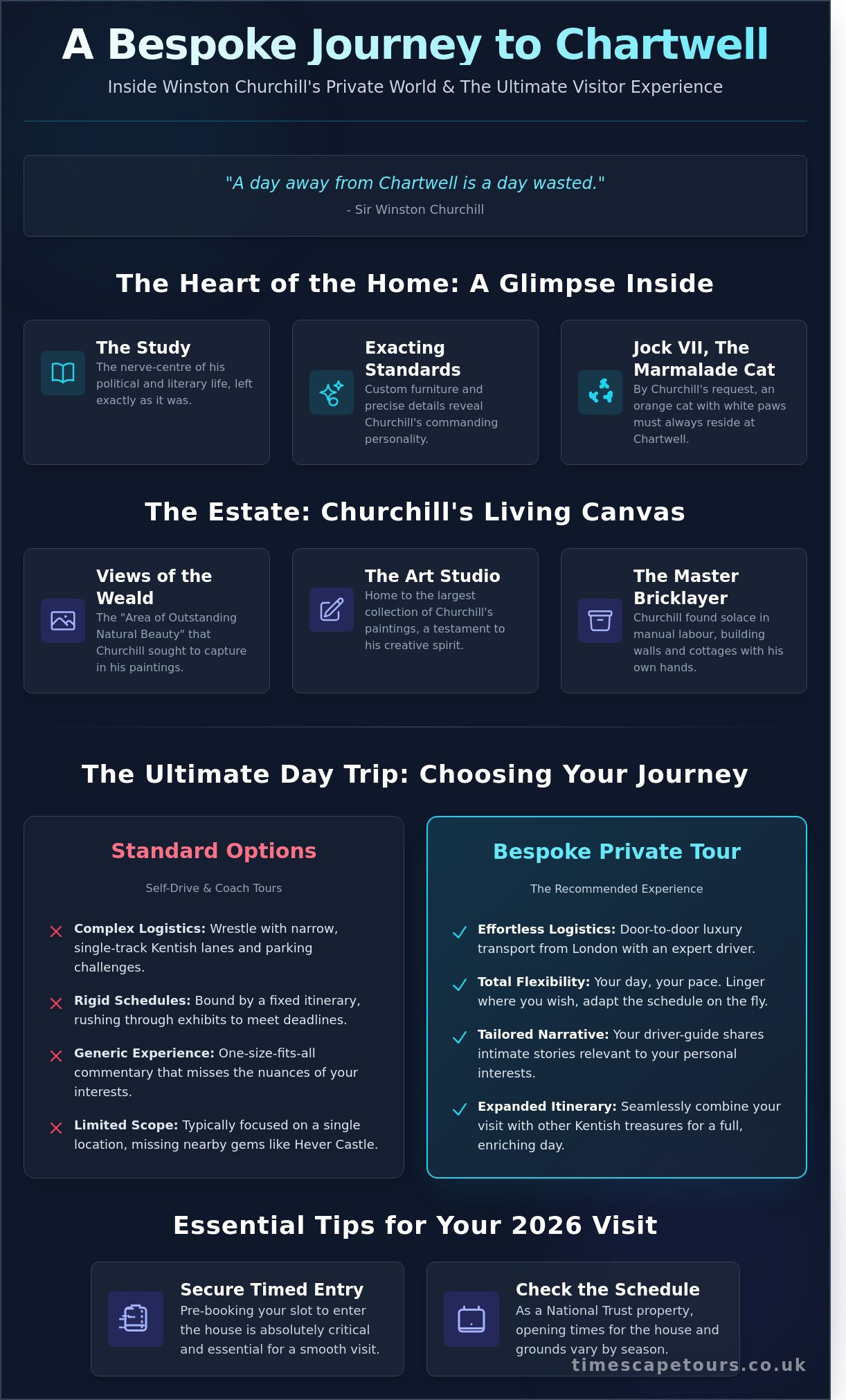
Walking through the halls of chartwell england, you immediately feel the weight of decisions that shaped the 20th century. This wasn't just a countryside retreat; it was a command center. In the Library and Drawing Room, the air still seems to hum with the echoes of "The Other Club," the exclusive dining society Churchill founded in 1911. These rooms hosted the brightest minds and fiercest political rivals of the era, often deep into the night. You'll see the Dining Room, where every detail reflects his precise nature. Churchill had exacting requirements for his custom furniture, even commissioning chairs with specific heights to ensure he could dominate the table talk comfortably during his legendary multi-course lunches.
Don't be surprised if you spot a flash of orange fur on the garden terrace or a windowsill. Per a request made on his 88th birthday in 1962, an orange tabby cat with white paws, always named Jock, must reside at the estate in perpetuity. We're currently on Jock VII, a charming fellow who carries on the tradition with modern feline grace. To truly grasp the man behind the myth, spend time with the "50 Objects" exhibition. It features deeply personal items like his heavy trench flashlight from the Western Front and his iconic gold-banded cigars. Understanding Churchill's life at Chartwell requires seeing these intimate relics up close, as they bridge the gap between the public hero and the private man.
The Study: The Engine Room of History
The heart of the house is the Study, a room that feels as though the Great Man just stepped out for a moment. Churchill famously preferred to work standing up; you'll see the high mahogany desk where he dictated the speeches that rallied a nation. This room birthed The Gathering Storm and his massive four-volume History of the English-Speaking Peoples. The walls are lined with maps and over 1,000 books, each a brick in his intellectual fortress. The scent of old leather and history is palpable here.
The Largest Collection of Churchill’s Paintings
A short walk to the garden leads to the Studio, the place where Churchill sought "hiding places" through art. He took up painting at age 40 to combat "the black dog" of depression, and it became his lifelong mental health refuge. The Studio houses over 500 canvases, the largest collection of his art in the world. Look for "The Goldfish Pool at Chartwell," painted in 1962; it's a poignant piece from his final years. If you'd like to explore these artistic sanctuary spaces, we can curate a bespoke itinerary that allows for a slower, more contemplative pace through the chartwell england estate.
The Gardens and Estate: Churchill’s Living Canvas
Winston Churchill didn't just reside at Chartwell; he physically shaped the very earth it stands upon. While the house holds the weight of history, the 80 acre estate reveals the man's restless energy and creative spirit. You'll find his presence most felt by the fish pond. He spent countless afternoons feeding his Golden Orfe, often finding more solace in their silent company than in the loud corridors of Westminster. It was a meditative ritual he cherished until his final years.
Nearby sits the Marycot, a charming brick playhouse he designed and built for his youngest daughter, Mary, in the mid 1930s. It stands as a miniature masterpiece of domestic architecture. Beyond the formal lawns, the interconnected lakes and complex waterworks showcase his engineering ambition. He personally directed the flow of water and designed the dams, creating a landscape that felt both ruggedly wild and meticulously ordered. Visiting chartwell england allows you to see how he balanced the roles of world leader and landscape architect.
A Hands-on Landowner
Churchill's love for the soil was literal. In 1928, he famously joined the Amalgamated Union of Building Trade Workers after constructing much of the kitchen garden's kitchen wall himself. This wasn't a staged hobby for the cameras. He found that the rhythmic laying of brick and mortar provided a vital escape from the pressures of global politics. The massive scale of the vegetable plots and the sturdy, slightly irregular walls reflect a personality that couldn't help but build on a grand, permanent scale.
Walking the Trails
When we explore the grounds together, I'll guide you to the Marlborough Pavilion for the ultimate estate photograph. The view looks back across the lakes toward the house, perfectly framed by the rolling Weald of Kent. To see the estate at its peak, consider these seasonal timings:
Spring: Arrive in mid April to witness the spectacular drifts of daffodils and narcissi.
Summer: The rose garden, designed with Lady Clementine, reaches its height in late June.
Autumn: Visit in October when the beech trees in the surrounding woodland turn a deep, fiery copper.
Don't limit your walk to the manicured borders. The woodland trails beyond the formal gardens offer a quieter perspective on the estate. These were the paths where the Great Man would often walk to dictate his speeches or ponder the future of the nation amidst the trees. It's a peaceful conclusion to a day spent at chartwell england, providing a moment of reflection before our return journey to London.
Planning Your Visit to Chartwell from London in 2026
Arranging a journey to chartwell england requires a touch of foresight to ensure your experience is as seamless as a diplomat’s schedule. As we look toward 2026, the National Trust continues to manage the estate with a focus on conservation, meaning opening times can fluctuate based on the season. Typically, the gardens and the Churchill exhibition open at 10:00 AM, while the house itself welcomes guests from 11:00 AM. It's vital to secure a timed entry slot for the house well in advance. These tickets are often fully booked weeks ahead, especially during the summer months, and without one, you'll be limited to the gardens and the studio.
The Best Time to Visit
Selecting a weekday for your private tour provides a much more intimate atmosphere than the busy weekends. The year 2026 marks the 60th anniversary of the National Trust opening Chartwell to the public in 1966, so expect special commemorative displays throughout the season. We recommend a mid-morning arrival to beat the coach crowds. This allows us to wander the hillside gardens while the dew is still on the roses before the midday sun hits the terrace.
Essential Visitor Information
If you aren't a National Trust member, expect to pay an entry fee of approximately £22.00 per adult in 2026. Members visit for free, though the timed entry requirement still applies to everyone. Once inside the house, please remember that photography is restricted to protect the original 1930s furnishings and Churchill’s personal effects. Comfort is key when exploring the 80-acre estate. You should wear sturdy walking shoes, as the paths are often uneven and the gradients are quite steep in places.
The Landemare Cafe, named after the Churchills' celebrated cook Georgina Landemare, is a delightful spot to sample Kentish produce. You might enjoy a traditional cream tea or a glass of local apple juice sourced from orchards just a few miles away. Before we depart, the gift shop offers a curated selection of memorabilia, from bespoke stationery to books detailing the Great Man's life. It's the perfect place to find a sophisticated memento of your day in the Weald of Kent.
If you're ready to experience this historic treasure without the stress of logistics, let us handle every detail of your bespoke private tour to Chartwell.
The Ultimate Day Trip: Why a Private Driver-Guide is Essential
Reaching Chartwell, England via public transport often turns a peaceful pilgrimage into a logistical puzzle. The typical route requires a train from London Bridge or Victoria to Sevenoaks, followed by a pre-booked taxi or a bus service that operates on a limited, seasonal schedule. Choosing a private driver-guide removes these hurdles entirely. You'll travel the 25-mile journey from Central London in the quiet sanctuary of an executive vehicle or an iconic London Black Cab, arriving refreshed and ready to explore the history of the Kentish countryside.
Your guide acts as more than a navigator; they're a curator of the 20th century. While a guidebook might list dates, a dedicated historian shares the intimate stories of Churchill’s life at his beloved home. You’ll hear about his 1922 purchase of the estate and his tireless work on the gardens, all while enjoying a bespoke itinerary tailored to your specific curiosity, whether that's his political legacy or his passion for oil painting. It's the difference between seeing a house and understanding a home.
Stringing Together Your Private Tour
We love to suggest places you'd like to string together into a private tour to maximize your time in the Garden of England. Because Chartwell England is situated in such a rich historical pocket, you can easily expand your day with these local gems:
Visit the 13th-century Hever Castle, the childhood home of Anne Boleyn, located just 20 minutes from the Churchill estate.
Stop in the picturesque village of Westerham to stand before the bronze statue of Churchill on the green and explore its quaint boutiques.
Pause for lunch at a traditional Kentish pub, perhaps a 16th-century inn serving local cider and seasonal fare by a roaring fire.
The Timescape Difference
The experience begins with a personalized pickup from your London hotel or residence at a time that suits your morning rhythm. There's no rushing for a train platform here; the day moves at your pace. If you find yourself captivated by the Golden Rose Garden or the studio where Churchill painted over 500 canvases, we simply stay longer. This flexibility ensures your experience is never dictated by a rigid group schedule. This style of unhurried, luxurious travel is a hallmark of great global tours, from private UK excursions to legendary rail journeys like the Palace on Wheels Train in India. You have the freedom to linger where the history feels most alive.
Begin Your Personal Journey Through Churchill’s Kentish Legacy
A visit to chartwell england offers a rare, intimate perspective on the man who steered Britain through its darkest hours. You'll step into rooms preserved exactly as they were in 1965 and stroll through a studio containing over 500 of Winston Churchill’s original oil paintings. To fully appreciate the nuances of this 80-acre estate during the 2026 season, the expertise of a professional is invaluable. Our expert, licensed driver-guides provide the historical context that guidebooks often miss, ensuring every moment is rich with insight. We travel in the quiet comfort of luxury executive vehicles or iconic Black Cabs, allowing you to relax while we handle the logistics of the Kentish countryside. We don't believe in rigid schedules; instead, we craft bespoke itineraries that move at your preferred pace. Whether you want to linger in the rose garden or spend extra time in the library, the day is yours to define. Design your bespoke private tour to Chartwell with Timescape Tours and let us create a memory that lasts a lifetime. We can't wait to share these stories with you.
Frequently Asked Questions
How far is Chartwell from London by car?
Chartwell sits approximately 28 miles south of central London. The journey typically takes 75 to 90 minutes by car, though traffic on the M25 can influence this timing. Traveling in an executive class vehicle ensures you enjoy the rolling hills of the Kent Weald in absolute comfort before arriving at the gates of this historic estate.
Can you visit Chartwell without a car?
You can reach Chartwell without a car, though the journey involves multiple transfers. Most visitors take a 35 minute train from London Bridge to Sevenoaks, followed by a 15 minute taxi ride or the seasonal 246 bus from Bromley. A private tour removes these logistical hurdles, providing a seamless door to door experience that saves you at least 2 hours of transit time.
When planning travel throughout the Southeast, arranging reliable transfers from key transport hubs is crucial. To get a sense of how professional local services operate, you can learn more about Brighton Airport Taxis, which handle airport routes in the neighboring Sussex area.
How long should I spend at Chartwell?
We recommend allocating at least 3.5 hours to fully experience chartwell england. This timeframe allows for a 45 minute guided tour of the house, a stroll through the terraced gardens, and a visit to the studio where Churchill painted over 500 canvases. If you wish to enjoy a traditional cream tea at the Landemare Cafe, plan for a 5 hour stay.
Do I need to book tickets for Chartwell in advance?
You should book your house entry tickets at least 14 days in advance to secure your preferred time slot. While the National Trust allows walk ins for the gardens, the house operates on a strict timed entry system to preserve the delicate interiors. We manage these bookings for our guests to ensure your bespoke itinerary remains perfectly synchronized throughout the day.
Is Chartwell suitable for children?
Chartwell is an excellent destination for families with children. Younger visitors often enjoy exploring the Marycot, a brick playhouse Churchill built for his daughter Mary in 1935, or following the woodland trails. The estate provides 80 acres of space for children to burn off energy while discovering the 1,000 year history of the surrounding Kent countryside.
What is the best way to get to Chartwell from central London?
The most efficient way to reach chartwell england from central London is via a private driver guide service. This option avoids the unreliability of regional trains and the 6 mile taxi journey from the nearest station. You'll travel in a luxury vehicle, arriving refreshed and ready to explore the 14th century origins and 20th century significance of Churchill's beloved home.
Is the house at Chartwell open all year round?
The house at Chartwell is typically open to the public from March until the end of October. During the winter months, from November to February, the house closes for essential conservation work, though the gardens and studio often remain accessible on weekends. Always check the specific 2026 calendar dates, as the National Trust completes deep cleaning of the 1920s furnishings during the off season.
Are there other Churchill sites near London to visit?
You can easily pair a visit to Chartwell with other iconic Churchillian sites like the Churchill War Rooms in Westminster. For a full day of historical immersion, we can string together a tour that includes Blenheim Palace in Oxfordshire, which is roughly 80 miles from Chartwell. This allows you to see both the 18th century birthplace and the private family retreat of Britain's greatest wartime leader.


Comments