


Churchill and Chartwell: A Private Guide to Sir Winston’s Country Home from London

Last September, a guest named Arthur discovered the quiet study where Sir Winston Churchill penned over 8 million words, looking out across the rolling Weald of Kent through the very windows he helped restore after purchasing the estate in 1922. For many travellers, the dream of visiting churchill and chartwell is often dampened by the reality of navigating Kent’s notoriously narrow country lanes or the rigid, hurried pace of a standard group bus tour. You likely want more than just a checklist of dates; you crave a genuine connection to the man who led Britain through its darkest hour, yet finding that intimacy in a crowded, self-guided environment is nearly impossible.
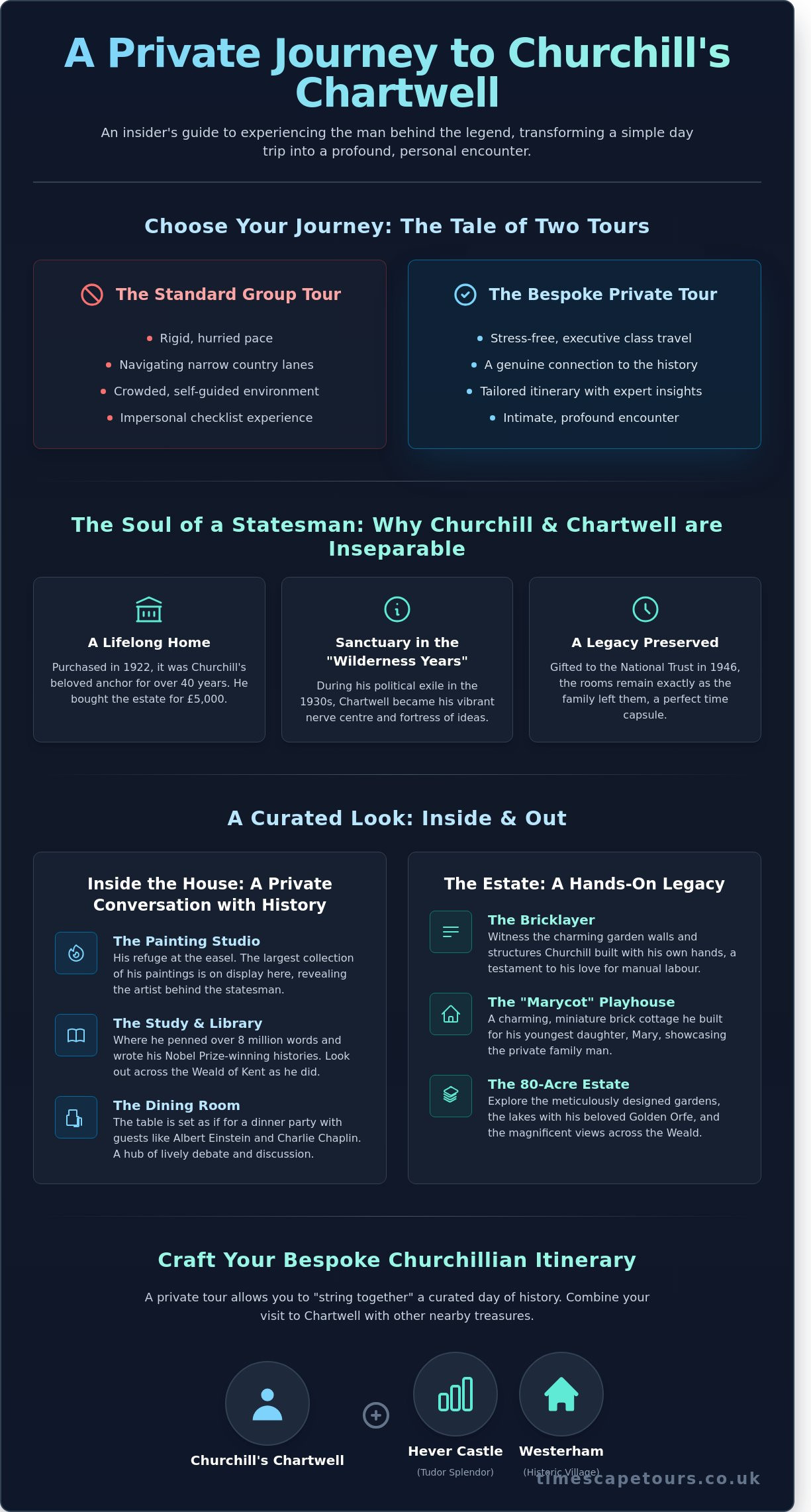
We believe your journey should be as distinguished as the history you're exploring. This bespoke private tour from your London hotel offers a stress-free, executive class experience that reveals the private father, painter, and bricklayer behind the iconic wartime persona. We’ll guide you through the hidden nuances of his beloved estate and perhaps even string together a visit to nearby Hever Castle or the historic village of Westerham. By the end of this guide, you'll see how a tailored itinerary transforms a simple day trip into a profound, personal encounter with Britain’s greatest leader.
Key Takeaways
Discover why Chartwell served as the vital sanctuary where Sir Winston found peace and purpose during his legendary "Wilderness Years."
Explore the intimate interior highlights, from the historic dining room to the private painting studio where Churchill sought refuge at his easel.
Witness the hands-on legacy of the 80-acre estate, including the charming "Marycot" playhouse and the garden walls Churchill built with his own hands.
Learn why a bespoke driver-guide provides the most sophisticated way to visit churchill and chartwell, removing the logistical hurdles of public transport.
Find inspiration for "stringing together" a curated day of history by pairing your visit with other nearby treasures like the Tudor splendor of Hever Castle.
Table of Contents The Soul of a Statesman: Why Churchill and Chartwell are Inseparable Inside the House: A Curated Look at the Painting Studio and Treasures The Gardens and Estate: Churchill’s Hands-On Legacy in Kent Navigating the Journey: Why a Private Driver-Guide Outshines the Train Crafting Your Bespoke Churchillian Itinerary from London
The Soul of a Statesman: Why Churchill and Chartwell are Inseparable
To understand the true essence of Sir Winston Churchill, one must look beyond the smoke-filled cabinet rooms of Whitehall and venture into the rolling greenery of the Kentish Weald. While London provided the stage for his political dramas, Chartwell was the sanctuary that nourished his soul. Purchased in September 1922 for the sum of £5,000, this estate became the primary anchor for a man who often found himself at odds with the political establishment. The deep connection between churchill and chartwell offers a narrative of resilience, where the domestic and the historic are woven into the very fabric of the landscape.
The house was never merely a residence; it was a workshop and a fortress. It was here, amidst the bricks he laid with his own hands and the gardens he meticulously designed, that the story of Sir Winston is best told through the walls of Churchill's beloved country home, Chartwell, where his private and public lives truly merged. For the discerning traveller, exploring this estate isn't just a tour of a house, it's an intimate encounter with the creative fire that sustained Britain's greatest wartime leader.
The "Wilderness Years" and the Kentish Sanctuary
During the 1930s, a decade famously defined as his 'Wilderness Years', Churchill was largely excluded from the inner circles of government. Far from falling into idle despair, his time at Westerham served as a vibrant nerve centre for 'The Focus'. This private intelligence network allowed him to gather critical data on German rearmament that official channels frequently ignored. The unhurried peace of the Kentish countryside provided the mental clarity he required to foresee the existential threats looming over Europe. Chartwell was the island hideaway that sustained Churchill during his political exile. It was within these rooms that he penned millions of words, finding inspiration in the view across the Weald to sustain his family and his political convictions simultaneously.
A Legacy Preserved by the National Trust
The survival of this iconic site is a testament to the profound affection Churchill commanded among his peers. In 1946, a group of his closest admirers and friends purchased the house to ensure he could remain there for the duration of his life before it was formally gifted to the National Trust. Today, the rooms remain curated exactly as they were when the family lived there during the pivotal 1920s and 30s. This preservation makes the estate one of the best day trips from London for history buffs seeking authenticity over artifice. Walking through the study where he composed his Nobel Prize-winning histories feels remarkably personal, as if the great man has simply stepped out into the garden for a moment to check on his Golden Orfe in the ponds below.
Inside the House: A Curated Look at the Painting Studio and Treasures
Stepping through the front door of Chartwell feels like walking into a private conversation with history. The house remains exactly as Lady Churchill left it in 1966, preserved with a warmth that suggests the family has only just stepped out for a walk in the gardens. In the dining room, where Sir Winston hosted figures like Albert Einstein and Charlie Chaplin, the table is set as if for a lively dinner party. It’s here that the connection between churchill and chartwell becomes most palpable; the house wasn't just a residence, but a sanctuary for his restless mind. To understand the broader context, one can look at the historical facts about Chartwell which detail how the estate evolved from its 14th-century origins into the iconic home we see today.
The interior is filled with personal artefacts that reveal the man behind the myth. You'll find:
His collection of ornate cigar humidors, still smelling faintly of Cuban tobacco.
The Nobel Prize for Literature, awarded to him in 1953 for his mastery of historical and biographical description.
Personal gifts from world leaders that sit alongside humble family photographs.
For those who appreciate such nuance, we can design a
that focuses on these hidden stories, allowing you to linger on the details that resonate with you personally.
The Painting Studio: Churchill’s Creative Refuge
Located a short stroll from the main house, the studio remains the most evocative space on the estate. It houses over 500 canvases, a staggering testament to his dedication to the craft. Churchill often retreated here to battle the "Black Dog" of his depression, finding solace in the play of light across the Weald of Kent. The room is flooded with natural light, smelling faintly of oil paint and turpentine. He once remarked, "Painting is a companion with whom one may hope to walk a great part of life’s journey."
The Library and the Study: Where History Was Written
The study serves as the intellectual engine room of the house. You'll see the very desk where he penned "A History of the English-Speaking Peoples" and his multi-volume memoirs. Nearby, the map room contains the charts used to track the progress of the Second World War between 1939 and 1945. These rooms possess a lived-in quality that makes history feel tangible. The books on the shelves aren't just for show; they're the tools of a man who shaped the modern world through the power of the written word. The synergy between churchill and chartwell is most palpable here, where the quiet of the Kent countryside provided the focus needed to lead a nation.
The Gardens and Estate: Churchill’s Hands-On Legacy in Kent
Winston Churchill didn't just live at Chartwell; he physically shaped the 80-acre landscape with his own hands. The breathtaking views over the Weald of Kent first captivated him in September 1922, prompting the purchase despite Clementine's initial reservations about the estate's upkeep. Walking the grounds today, you see a statesman's vision rendered in earth and stone. One of the most touching features is the "Marycot," a miniature brick playhouse he designed and built in 1935 for his youngest daughter, Mary. It stands as a testament to his devotion as a father, tucked away in a quiet corner of the garden where the family's private life flourished away from the public eye. He was a man of immense energy who couldn't simply sit still while at home.
The Golden Orfe and the Lakes
Churchill found a unique peace beside the water. He spent hours perched on a wicker chair, feeding his beloved Golden Orfe with maggots kept in a matchbox. This wasn't merely a passive hobby. He personally oversaw the complex engineering of the lakes, even when it meant battling the stubborn Kentish clay that caused frequent leaks and technical frustrations. While Winston focused on the water and the heavy lifting, Clementine curated the botanical elegance of the grounds. Lady Churchill’s Rose Garden remains a highlight, offering a refined contrast to the rugged landscape projects her husband favoured. Understanding Churchill's life at Chartwell reveals how these outdoor spaces provided the mental clarity he needed during his difficult "wilderness years" in the 1930s.
The Bricklayers Arms and Physical Labour
Perhaps the most surprising aspect of churchill and chartwell is the evidence of his manual labour. Churchill was a card-carrying member of the Amalgamated Union of Building Trade Workers, having joined in 1928 after proving his proficiency with a trowel. He built the massive kitchen garden walls and even assisted in constructing several cottages on the estate, including a summer house. This physical exertion served as a "manual escape" from the crushing pressures of political life and the looming threat of war. It reveals a man who needed to see tangible, solid results, a stark contrast to the often intangible world of diplomacy and debate. You can still run your hands over the bricks he laid, feeling the literal foundations of his private sanctuary. This hands-on approach to his estate reflects the same determination he brought to the Cabinet Room.
The estate encompasses 80 acres of woodland, gardens, and farmland.
Churchill's bricklaying projects include the high wall surrounding the kitchen garden.
The "Marycot" remains perfectly preserved, complete with its own tiny garden.
Feeding the fish was a daily ritual that Churchill used for quiet contemplation.
The relationship between churchill and chartwell was symbiotic. The house and its grounds gave him the strength to lead, while his constant improvements gave the estate its unique, personal character. It’s a place where the grandeur of history meets the simple joy of a man working his own land.
Navigating the Journey: Why a Private Driver-Guide Outshines the Train
While Sir Winston cherished the seclusion of his Kentish retreat, that very isolation presents a modern logistical hurdle for travellers arriving from the capital. Reaching the village of Westerham via public transport often involves a fragmented combination of mainline trains from Victoria or Charing Cross, followed by a precarious reliance on local taxis that aren't always waiting at the station. It's a stressful start to a day meant for historical reflection. Choosing a private journey transforms this 25-mile transit into a seamless, bespoke extension of the experience itself.
The Logistics of Luxury: London to Kent
The route from central London takes us through the rolling greenery of the North Downs, a landscape designated as an Area of Outstanding Natural Beauty since 1968. In the comfort of an executive vehicle, the 90-minute journey becomes a curated preamble rather than a commute. We have the flexibility to pause in the historic market square of Westerham to view the bronze statue of Churchill, a luxury simply not afforded by rigid bus schedules. Much like the effortless transition found on a private Windsor Castle tour, our door-to-door service removes the friction of urban sprawl. We'll collect you directly from your Mayfair hotel or Chelsea residence at a time that suits your morning rhythm, ensuring you arrive at the estate refreshed and ready to explore.
The Driver-Guide Advantage
A qualified historian at the wheel does more than navigate the winding lanes of Kent; they provide the vital historical scaffolding for your visit. As we drive, we'll discuss the 1922 purchase of the estate and the "Wilderness Years" that defined Churchill's mid-career. This intellectual preparation means that by the time you step onto the grounds of churchill and chartwell, you aren't just looking at a brick facade; you're entering a familiar sanctuary.
Our executive-class fleet offers a quiet, climate-controlled environment where you can ask specific questions and tailor the day's focus. We handle the parking and entry logistics, allowing you to bypass the confusion of the visitor car parks. The benefits of a private guide include:
Historical Context: Deep-dive discussions into the events of the 1930s during the transit.
Bespoke Flexibility: The ability to adjust our return time if you wish to linger in the rose gardens.
Executive Comfort: Premium seating and refreshments that no commuter train can match.
Expert Navigation: Avoiding the congestion of the M25 through local knowledge of Kentish backroads.
By the time we arrive at churchill and chartwell, the narrative of his life is already vivid in your mind, making the physical tour far more impactful.
Ready to explore the Kentish countryside in sophisticated comfort?
.
Crafting Your Bespoke Churchillian Itinerary from London
One of the greatest joys of a private driver-guide service is the freedom to "string together" historical sites that a standard coach tour would never dream of connecting. While your primary focus might be the life of the Great Man, the rolling hills of Kent offer a rich tapestry of English heritage waiting to be explored. We don't believe in rigid schedules; instead, we treat your day as a blank canvas where we can blend different eras of British history into one seamless, executive-class experience.
Chartwell and Hever Castle: A Royal Pairing
Just 8 miles away from the churchill and chartwell estate lies Hever Castle, the childhood home of Anne Boleyn. This pairing offers a striking contrast between 13th-century medieval defensive architecture and the 20th-century domesticity of the Churchill family. You can walk through the rooms where Henry VIII courted his second queen in the morning, then spend your afternoon in the very study where the 1940s war effort was mentally forged. It's a fluid way to bridge 700 years of history in a single day. If you enjoy these multi-layered journeys, you might also find inspiration in our Stonehenge and Bath guide, which illustrates how we balance iconic landmarks with hidden gems.
The Village of Westerham and Beyond
A short drive brings us to the picturesque village of Westerham, an essential stop for any enthusiast. It's the perfect spot for a traditional pub lunch after a morning of exploring. On the village green, you'll find a bronze statue of Winston Churchill that was unveiled in 1969 by Lady Clementine herself. It's a quiet, local tribute that feels far more intimate than the grand monuments of Parliament Square.
For those interested in a "War and Peace" theme, we can extend our journey to the Battle of Britain Memorial at Capel-le-Ferne. Perched on the white cliffs of Dover, this site provides a poignant connection to the "Few" whom Churchill so famously praised during the summer of 1940. Alternatively, scientific minds might choose to visit Down House, located about 15 minutes away, where Charles Darwin lived and worked for 40 years. Every journey I lead is entirely flexible and built around your interests. Please reach out to me, Mark Cairns, to begin the conversation. We'll work together to design your bespoke Churchill and Chartwell tour with Timescape today and ensure your visit to the English countryside is nothing short of extraordinary.
Step Into the Private World of a Statesman
Chartwell represents more than a mere residence; it's the 80 acre sanctuary where Winston Churchill found his greatest inspiration. When you walk through the studio containing over 500 of his original paintings, you witness a side of the Great Briton that history books often overlook. Choosing a private journey over the uncertainty of public transport ensures your focus remains on the heritage. You'll travel from London in a fully licensed and insured executive class vehicle, guided by an expert who brings 20th century history to life. We're proud to be rated 5-stars for our bespoke London day trips, a testament to our commitment to quality and historical depth. A visit to churchill and chartwell offers a profound look at the man's private passions and his public legacy. We'll handle every detail, from the route through the Kentish countryside to the pace of your day. You deserve a journey that's as refined and intellectually stimulating as the destination itself.
We look forward to welcoming you on a truly memorable exploration of Churchill's beloved home.
Frequently Asked Questions
How far is Chartwell from central London by car?
Chartwell lies approximately 25 miles south of central London in the verdant county of Kent. When we set out in our executive class vehicle, the journey typically takes between 60 and 90 minutes; we'll navigate through the leafy suburbs before reaching the rolling hills of the Weald. It's a pleasant drive that transitions from the city's bustle to the serene countryside Sir Winston loved so dearly.
Can you see the inside of Chartwell House?
You can certainly explore the interior of Chartwell House, which remains much as it was when the Churchill family lived there during the 1920s and 1930s. Visitors can walk through the library, the drawing room, and the study where Sir Winston composed his most famous speeches. Because the National Trust preserves the rooms with historical authenticity, you'll see personal items like his cigar boxes and his Nobel Prize for Literature.
Is Chartwell suitable for visitors with limited mobility?
Chartwell offers specific accessibility features for visitors with limited mobility, including a lift that provides access to the first floor of the house. While the hillside gardens feature steep gradients and uneven paths, the National Trust provides a volunteer-led buggy service that operates daily to assist guests in reaching the higher points of the estate. We'll ensure your visit is paced comfortably, focusing on the most accessible routes through the house and the studio.
What are the opening times for Chartwell in 2026?
In 2026, the house at Chartwell generally opens from 11:00 until 16:20, while the gardens and shop are accessible from 10:00 until 17:00. These times vary slightly during the winter months of November and December when the house often closes for conservation work. We always verify the specific schedule for your chosen date to ensure your bespoke tour of churchill and chartwell aligns perfectly with the site's daily operations.
Do I need to book tickets for Chartwell in advance?
Booking tickets in advance is highly recommended because the National Trust operates a timed entry system for the house to prevent overcrowding. During the peak summer months of June and July, time slots often sell out 48 hours before the date of visit. As part of our service, we'll manage these arrangements for you; this ensures you don't miss the chance to see the iconic rooms where history was written.
Can I combine a visit to Chartwell with other sites in Kent?
We can easily combine your churchill and chartwell visit with other historic gems in the Garden of England, such as Hever Castle or Knole House. Hever Castle, the childhood home of Anne Boleyn, is located just 20 minutes away by car and offers a fascinating Tudor contrast to the 20th-century history of Chartwell. We'll help you string together these sites into a seamless, full-day private tour that reflects your specific historical interests.
Is there a place to eat at Chartwell or nearby in Westerham?
You'll find the Landemare Cafe on the Chartwell estate, named after the Churchills' cook, which serves hot lunches and traditional cream teas. If you'd prefer a more traditional village experience, we can drive 2 miles into Westerham to dine at The Grasshopper on the Green, a pub dating back to the 18th century. Westerham's high street also offers several refined independent cafes that provide a lovely setting for a midday break.


Comments